
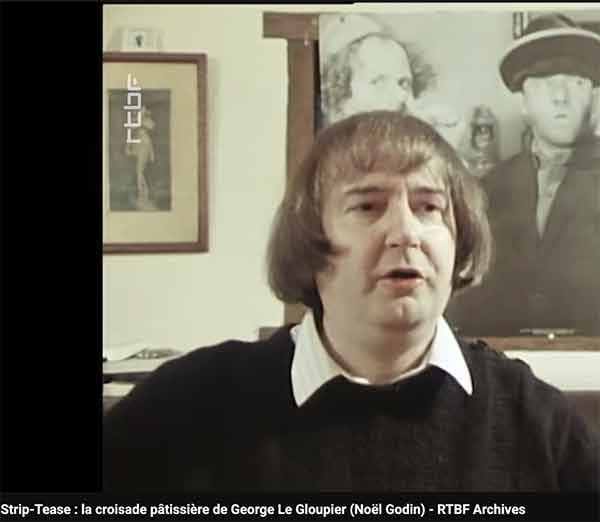
 Noël Godin was a Belgian humorist, film critic, provocateur and lifelong practitioner of the absurd who spent much of his life reminding the powerful that dignity is often nothing more than a costume, and that even the most solemn public figure can be reduced to a ridiculous human being with a face covered in whipped cream. Better known as Georges Le Gloupier, or simply the Gloupier, Godin turned the cream pie into an instrument of satire and transformed what might otherwise have been dismissed as childish mischief into one of the most recognizable forms of Belgian cultural irreverence of the past half century.
The character of the Gloupier was itself part of the joke. Godin borrowed the name from a fictional, many faced character created by Jean-Pierre Bouyxou, and then gradually allowed this imaginary troublemaker to escape from the pages of fiction and take on a life of his own. The first great demonstration of that idea came in 1969, when Godin targeted Marguerite Duras in Leuven. The episode was not simply a spontaneous prank. Godin had already written about the fictional Gloupier and imagined him committing precisely such acts, and when Duras appeared in Belgium, he decided to make fiction reality. In doing so, he established the essential principle that would govern the rest of his career: the joke was always better when the imaginary world and the real world suddenly collided.
From that moment onward, the Gloupier became a kind of underground theatrical character, appearing without warning at public events and cultural gatherings, usually accompanied by accomplices who understood the choreography. Godin would approach his target, often in front of television cameras and newspaper photographers, shout his unmistakable cry, “Gloup, gloup, gloup, I am the Gloupier,” and then deliver the final blow, a cream pie pressed directly into the face of someone who had acquired, in Godin’s judgment, far too much importance.
The list of his targets eventually became a curious alternative history of European celebrity. Politicians, writers, actors, filmmakers, businessmen and television personalities all found themselves vulnerable. Maurice Béjart, Jean-Luc Godard, Nicolas Sarkozy, Patrick Poivre d’Arvor and Bill Gates were among those who discovered that international fame did not necessarily provide protection against a Belgian man carrying a pie. But no one became more closely associated with the Gloupier than Bernard-Henri Lévy.
Lévy was, in many ways, the perfect Godin target. He was not merely a writer or philosopher but a public intellectual whose appearance, clothing, political interventions and omnipresence in the French media had made him a recognizable cultural institution in his own right. To Godin, there was something irresistibly pompous about a man who seemed determined to occupy simultaneously the roles of philosopher, political commentator, moral authority, celebrity and friend of the powerful. The Gloupier’s answer to all of this was wonderfully primitive. Instead of debating Bernard-Henri Lévy, he put a pie in his face.
The first encounter between the two men took place in 1985, and it would become the beginning of one of the longest running feuds in the history of European comic provocation. Lévy did not regard the incident as particularly funny and reacted with considerable anger, which, from Godin’s perspective, only improved the performance. The more seriously the philosopher treated the attack, the more perfectly he played the role that Godin had written for him. Over the years, Lévy would be entarted again and again, becoming perhaps the most famous recurring victim of the Gloupier. The number is generally given as eight.
There was something almost Shakespearean about the relationship, except that Shakespeare would probably have required a more respectable prop. Lévy represented the solemn world of intellectual authority, political influence and European public debate; Godin represented the court jester who wandered into that world carrying whipped cream. One man had books, television appearances and access to presidents. The other had a pastry. Yet somehow the pastry kept winning.
I had the opportunity to meet Noël Godin several times and to talk with him, and what struck me most was how little malice there was in the man behind the Gloupier. The public image suggested an anarchic troublemaker, someone permanently looking for his next victim, but the man I encountered was much closer to the old idea of the court jester, someone who could mock the powerful without necessarily hating them. His provocations were rarely driven by personal cruelty. They were driven by an almost childlike pleasure in making the serious ridiculous.
That distinction is important because it explains why Godin remained strangely difficult to classify. He was not really an activist, although his actions sometimes carried political implications. He was not simply a comedian, because his performances were often staged outside the conventional world of entertainment. He was not an anarchist in the traditional political sense, although he clearly enjoyed challenging authority. He was something more elusive: a professional irritant to solemnity.
There was, in fact, a distinctly Belgian quality to what he was doing, and to understand the Gloupier properly it helps to look beyond the pies and back into the peculiar history of Belgian surrealism. The country has produced a remarkable tradition of artists who understood that the most effective way to undermine an apparently stable reality is not necessarily to confront it directly, but to make it suddenly absurd.
James Ensor was one of the early masters of this approach. His paintings filled the respectable world with masks, skeletons, grotesque faces and carnival crowds, turning society itself into a theater in which everyone appeared to be wearing a disguise. Ensor’s work was not simply grotesque for the sake of being grotesque. The masks suggested that beneath the respectable appearance of civilization there was something far less orderly, and often far more ridiculous.
René Magritte took the idea in another direction. His great achievement was to make ordinary things suspicious. A pipe could cease to be a pipe. A bowler hat could become an emblem of mystery. A man could float through the sky beneath an umbrella. Words could contradict images, and images could contradict everything the viewer thought he knew. Magritte’s genius was to make the familiar strange without ever completely explaining the joke.
His famous painting of a pipe accompanied by the words “This is not a pipe” remains one of the clearest expressions of that Belgian instinct. The image looks simple, almost childish, until the viewer realizes that Magritte has quietly dismantled the relationship between an object, its image and the word used to describe it. The joke is philosophical, but the philosophy works because the joke comes first.
Noël Godin took that same instinct and moved it out of the museum and into the street. Magritte made language betray the image; Godin made celebrity betray itself. Magritte asked the viewer to question what appeared obvious. Godin asked the public to question why certain people were treated as untouchable in the first place. The technique was less sophisticated, perhaps, but the underlying impulse was surprisingly similar.
The same tradition can be traced through Marcel Broodthaers, whose work repeatedly questioned the authority of museums, institutions, classifications and cultural conventions, and through Philippe Geluck, whose absurdist humor turned the apparently innocent conversations of a philosophical cat into a sustained exercise in undermining human logic. In Belgium, absurdity has rarely meant simple nonsense. It has often been a way of looking at authority from the side, refusing to confront power on its own terms.
That may explain why Godin’s pies were more than just pies. They were tiny acts of cultural sabotage. The victim arrived surrounded by the symbols of importance: security guards, television crews, journalists, admirers, official ceremonies and the invisible aura of celebrity. Then, for one glorious second, all of it disappeared beneath a layer of cream.
Bill Gates experienced the phenomenon in Brussels in 1998, when the Microsoft founder was caught in one of Godin’s most famous operations. Gates was then one of the most powerful figures in the technology industry, a billionaire whose name had become synonymous with the extraordinary transformation of the modern economy. Yet for Godin, the mathematics of the situation were wonderfully simple: the more powerful the man, the funnier the pie.
There was something profoundly democratic about that. The Gloupier did not need to defeat Bill Gates in an argument about technology or capitalism. He did not need to write a book about Microsoft. He did not need an audience of thousands. For a few seconds, he simply made one of the most powerful businessmen on the planet look like everybody else.
That was also the secret of his attacks on Bernard-Henri Lévy. Godin could never compete with Lévy in the traditional arena of intellectual prestige, nor did he intend to. He chose a different battlefield, one in which intellectual credentials, political connections and celebrity were irrelevant. A philosopher can spend years constructing an image of authority, but a cream pie requires only a few seconds to remind everyone that underneath the carefully cultivated public persona there is still a human face.
Perhaps that is why Lévy became such an irresistible figure in Godin’s mythology. Their confrontation was no longer simply between two individuals. It became a clash between two visions of public life. On one side stood the grand intellectual, speaking about history, politics, war and morality. On the other stood the Gloupier, asking the most irritating question imaginable: what if none of this is quite as important as you think it is?
The joke became so famous that it eventually escaped Godin himself. Renaud turned the saga into the song “L’Entarté,” transforming Lévy into a character in a much larger popular joke. By then, the cream pie had become part of the mythology, and the Gloupier had acquired something rare for a provocateur: an identity that people could recognize even before they saw his face.
What makes Godin’s disappearance particularly poignant is that the culture in which he flourished seems to be disappearing as well. He belonged to a Europe in which provocation, surrealism, political satire and childish irreverence could coexist without every joke immediately becoming a referendum on the moral character of the person who made it. That world was hardly perfect, and Godin himself occasionally found himself on the wrong side of the law, but there was still room for people to behave foolishly in public without the entire society demanding that the foolishness be converted into a political doctrine.
Today, comedians and satirists operate in a far more nervous environment. The speed of social media means that a joke can travel around the world before anyone has decided whether it was actually funny. Public figures are surrounded by communications advisers, lawyers and carefully managed images, while comedians increasingly learn to anticipate outrage before they even reach the punchline. The result is not necessarily a healthier culture. It can simply be a more cautious one.
This does not mean that everything should be permissible in the name of humor, nor that every act of provocation deserves applause. Some jokes are cruel; some humiliations are gratuitous and some forms of comedy genuinely hurt people. But a society that loses the ability to distinguish between a joke and an offense, or between ridicule and genuine danger, eventually becomes incapable of laughing at its own institutions. And once that happens, power becomes considerably more comfortable.
Noël Godin understood the value of discomfort. He also understood something that many professional comedians forget: absurdity does not require a complicated explanation. Sometimes the explanation is the cream pie itself.
His disappearance marks the end of an unusually long chapter in Belgian cultural life. Born in 1945, Noël Godin died in Brussels on August 23, 2026, at the age of 80. For half a century, he had played the same improbable character, refining a joke that began as a piece of fiction and eventually became a kind of personal mythology.
Yet those who knew him are unlikely to remember him simply as the man who entarted Bill Gates, Bernard-Henri Lévy or any of the other famous figures who crossed his path. They will remember a man who seemed to have preserved something increasingly rare: the ability to look at the adult world, with all its ceremonies, hierarchies, titles and solemn declarations, and still see the enormous childlike possibility of doing something completely ridiculous.
That was the Gloupier’s great gift. He reminded people that the emperor might not be wearing very much after all, and that sometimes the most effective way to puncture the inflated importance of a public figure is not with an argument, a manifesto or a television debate, but with a pie.
With Noël Godin gone, a little of that old Brussels spirit has gone with him. It was the spirit of Magritte, Ensor and Broodthaers, of carnival and contradiction, of the joke hidden inside the serious statement and the serious idea hiding inside the joke. It was an attitude that did not necessarily seek to destroy authority but refused to bow before it.
The Gloupier understood that perfectly. He looked at the powerful and saw ordinary people. He looked at solemnity and saw comedy waiting to happen. And when the moment came, he ran toward it shouting his absurd battle cry, surrounded by accomplices and armed with whipped cream.
For those who knew him, there was always something wonderfully innocent about that. He had the mischievous gaze of a child who has just thought of doing something he probably should not do, and who somehow knows that, when the inevitable trouble arrives, everyone will forgive him because the joke was simply too good.
That childlike gaze is gone now. The laughter, fortunately, remains.
Thierry De Clemensat
French journalist Based in Austin, Texas, Writes on Jazz, Culture and Global Society
Image RTBF, magazine Strip-Tease ” La ccoisade patissiere de George Le Gloupier)