
 There was a time when France could still imagine itself as a relatively peaceful country, sustained by a shared political culture, a strong public sector, a sense of social solidarity and the conviction that, despite its inequalities, the nation remained capable of correcting its own excesses. This was never the whole truth. Beneath the republican ideal lay class divisions, colonial legacies, geographical inequalities and the persistent exclusion of entire communities from the promise of equality. Yet the ideal mattered. It offered a common language through which conflicts could be expressed, compromises negotiated and injustice challenged. Today, that language is losing its authority. France has not ceased to exist as a state, nor has its society simply collapsed into disorder. Something more insidious is taking place: the gradual disintegration of the bonds that allow a country to recognize itself as a political community. Institutions remain in place, elections are held, ministers speak in the name of the nation, and the machinery of government continues to function. But the distance between the country as it is governed and the people in whose name it is governed has become so pronounced that the very idea of a common destiny seems increasingly difficult to sustain.
The crisis is often described in terms of political instability, public debt, immigration, insecurity or the rise of the far right. Each of these issues is real, but none, taken in isolation, explains the depth of the malaise. France is confronting a crisis of legitimacy: a growing conviction that the institutions designed to represent the public interest no longer respond to ordinary people’s lives, while those who exercise power have become increasingly insulated from the consequences of their decisions. The erosion of trust has not occurred overnight. It is the cumulative result of decades of economic restructuring, the weakening of organized labor, the retreat of public services from neglected territories, the concentration of wealth and decision-making, and a political culture that too often treats citizens as an audience to be managed rather than a public to be heard. The anger that has erupted in the streets is therefore not merely a reaction to one government or one reform. It is the expression of a deeper exhaustion, the feeling that the social contract has been steadily rewritten without the consent of those expected to live under it.
Emmanuel Macron’s presidency has brought this contradiction into particularly sharp focus. His political project promised modernization, efficiency and the transcendence of old ideological divisions. In practice, it has reinforced the impression that political power is exercised from above, with limited patience for dissent and an expansive understanding of executive authority. The repeated resort to constitutional mechanisms that allow governments to advance major measures without a full parliamentary vote, most notably Article 49.3, has helped turn procedural legality into a source of political resentment. A government may be entitled to use the powers granted by the Constitution and still undermine public confidence in the democratic process. Legality and legitimacy are not interchangeable. When citizens repeatedly hear that decisions affecting their working lives, pensions, schools and public services are necessary, unavoidable or beyond serious debate, they begin to suspect that democratic participation is little more than a ritual performed after the essential choices have already been made. The problem is not simply that Macron has pursued unpopular policies. It is that his style of government has come to embody a wider refusal to treat social opposition as a legitimate force capable of changing the direction of public policy.
The consequences are visible well beyond the corridors of power. In towns once sustained by factories, mines, workshops and local commerce, the disappearance of stable employment has taken more than income with it. It has weakened institutions, hollowed out high streets, diminished the prospects of younger generations and deprived communities of the feeling that their work remains necessary to the country. In rural areas and small cities, access to medical care, public transportation, administrative services and education has become increasingly precarious. In working-class suburbs, the promise of equal citizenship often collides with overcrowded schools, insecure employment, inadequate housing and a relationship with public authority shaped by suspicion. These places are frequently discussed as problems to be managed, populations to be monitored or electoral territories to be won. Too rarely are they understood as places where people are making a clear judgment about the country they have been left with. The anger that emerges from such circumstances is neither inexplicable nor reducible to resentment. It is also a response to the experience of being told, year after year, that economic progress is underway while the material conditions of everyday life continue to deteriorate.
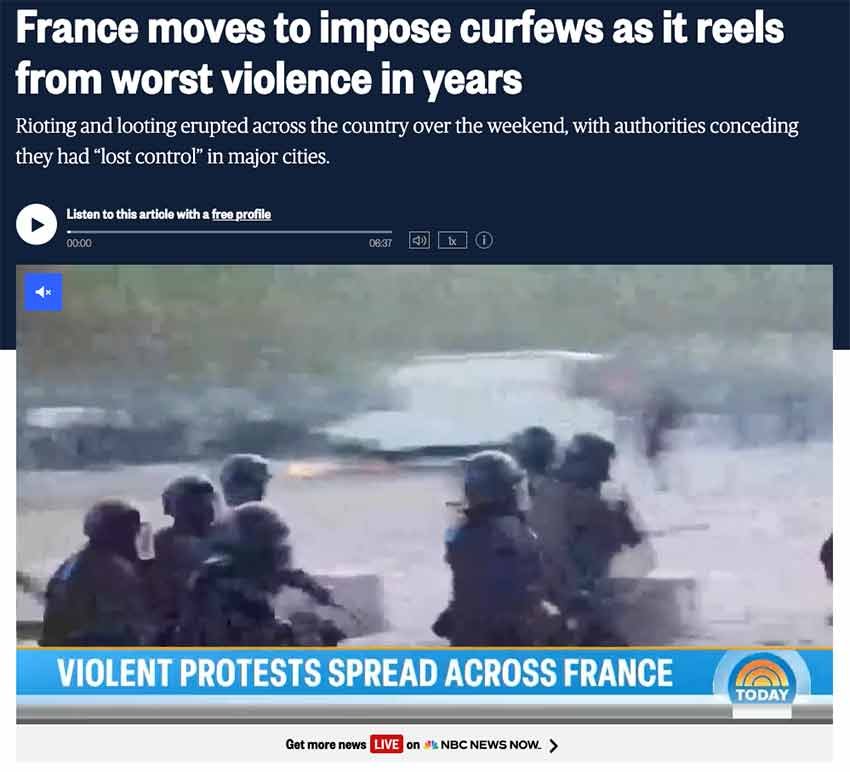
This fracture has become especially visible in the education system, where the future of the republic is supposed to take shape. Schools are asked to compensate for inequalities they did not create, to integrate children whose families face economic insecurity, to provide social mobility while operating under mounting pressure, and to preserve a common civic culture in a society increasingly divided by wealth and opportunity. Yet the institutions entrusted with this mission are themselves strained by inadequate resources, deteriorating facilities, staffing shortages and a growing sense among students that the promises made to them are no longer credible. When young people take to the streets to demand better schools and a more meaningful future, their protest should be understood as a political act, not simply a disturbance of public order. The response to the recent student demonstrations has exposed the extraordinary distance between the language of republican education and the reality of state power. Teenagers demanding better conditions have encountered mass arrests and the use of weapons capable of causing devastating, irreversible injuries. In Lens, a 15-year-old student lost a hand in an incident involving a police grenade. In Saint-Ouen-l’Aumône, a 14-year-old boy suffered severe facial injuries after being struck at close range by a grenade fired from a Cougar launcher. Other young demonstrators have sustained serious injuries, prompting judicial investigations and renewed scrutiny of police tactics. The precise circumstances and individual responsibilities in these cases must be established through independent investigations. But no investigation can erase the political significance of the images or the questions they raise about the state’s response to children exercising their right to protest.
The violence of these encounters cannot be understood solely as a matter of individual misconduct. France has developed a public-order doctrine in which the management of demonstrations increasingly relies on forceful intervention, extensive use of crowd-control weapons and a willingness to treat disorder itself as a failure that must be prevented at almost any cost. This approach has consequences. When the threshold for intervention falls, when dispersal becomes an objective in itself and when demonstrators are treated less as citizens exercising a right than as threats to be contained, the likelihood of injury rises. The state has a duty to protect people from violence, including violence directed at police officers. Officers themselves have a right to safety and must not be subjected to attacks. But the protection of public order cannot become a justification for disproportionate force, nor can the injuries inflicted by state agents be dismissed as an unfortunate price of maintaining control. The use of so-called less-lethal weapons does not make their consequences less real. A grenade can destroy a hand, a projectile can blind a teenager, and a strike delivered at close range can permanently alter a young person’s life. When such injuries occur during demonstrations, the question is not whether the state should be capable of maintaining order. It is whether the way it does so remains compatible with the rights and dignity it claims to defend.
Under Macron, the use of institutional and police power has become one of the defining features of the country’s political crisis. This is not to claim that police violence began with his presidency, or that every confrontation can be attributed to a single administration. France has a long history of violent policing, particularly in working-class neighborhoods and during demonstrations. What has changed is the extent to which force has become intertwined with the government’s broader response to political dissent, reinforcing a perception that opposition is something to be subdued rather than addressed. The handling of the Yellow Vest movement, the confrontations over pension reform and the repeated clashes surrounding environmental and social protests have contributed to this perception. The recent injuries suffered by teenagers have made it particularly difficult to sustain the argument that these are isolated episodes unrelated to a larger political pattern. A government that presents itself as the guardian of republican institutions cannot indefinitely ignore the contradiction between its democratic vocabulary and the coercive practices deployed in its name. When the state responds to a crisis of trust with displays of force, it may regain control of a street for an afternoon. It risks losing something more important over the long term: the belief that its authority deserves to be recognized.
The damage extends beyond the immediate victims. Public confidence depends not on the absence of conflict but on the belief that institutions can arbitrate conflict fairly. Once that belief weakens, every police intervention becomes a potential symbol of injustice, every official explanation is received with suspicion, and every new injury deepens the conviction that the rules are applied differently depending on who is standing in the street. This does not mean that all accusations against the police are necessarily justified, any more than every act committed in a demonstration can be excused by the grievances that preceded it. A democratic society must be able to distinguish peaceful protest from assault, legitimate criticism from intimidation, and necessary policing from abuse. But such distinctions can only command public confidence when investigations are independent, accountability is credible and the authorities are willing to acknowledge failures. Blanket defenses of police conduct, reflexive denunciations of demonstrators and the reduction of complex social movements to the actions of a violent minority do the opposite. They transform an argument about responsibility into a struggle over competing realities, leaving fewer spaces in which the public can agree on what happened and what justice requires.
The crisis of representation is equally evident in the political system. The fragmentation of the traditional parties, the weakening of the center-left and center-right, and the growth of movements that define themselves in opposition to the established order have left France with a political landscape increasingly organized around rejection. The far right has benefited from the conviction that mainstream governments have failed to protect living standards, public services, national cohesion and democratic accountability. Its appeal cannot be understood solely as the product of prejudice or manipulation, even though its rhetoric and proposals must be examined critically. It also draws strength from grievances that established parties have failed to address convincingly. The danger is that legitimate anger may be converted into a politics of exclusion, in which social suffering is blamed on minorities, immigrants or imagined enemies rather than on the economic and institutional arrangements that have produced it. The far left, meanwhile, has sought to channel discontent into a more confrontational challenge to economic inequality and executive power, but the polarization of political life has made durable coalitions increasingly difficult to build. Between these competing forces, the political center has lost much of its former authority. Its promise of competence and moderation rings hollow when it appears unable to offer either meaningful social protection or a convincing democratic alternative.
The deeper problem is that France has become more difficult to govern because it has become harder to persuade. Governments can issue decrees, pass budgets, deploy police and invoke the authority of the state. They cannot command trust by administrative means. Nor can they rebuild a common political culture through speeches about national unity while leaving the underlying causes of division untouched. A country is not held together simply by borders, laws or the continued operation of public institutions. It also depends on a shared understanding that burdens and opportunities are distributed according to principles that people can recognize as fair, that sacrifice is not demanded only from those with the least power, and that the future remains open to those who do not inherit wealth or influence. When these assumptions weaken, citizenship becomes increasingly formal. People retain their legal status, but the sense of belonging to a collective project fades. They begin to see the state not as the embodiment of a common undertaking but as an apparatus standing above them, capable of demanding obedience while offering little in return.
Economic inequality is central to this unraveling, but the issue is not merely the distance between the richest and poorest households. It is also the widening divide between those who can absorb uncertainty and those for whom a single setback can destabilize an entire life. For affluent households, economic change may mean a new investment strategy, a different career or a move to another city. For a worker facing redundancy, a parent waiting months for specialist medical care, a student attending an underfunded school or a family dependent on public transportation, the same change can mean a loss of security that is difficult to recover. The language of competitiveness and reform often obscures this asymmetry. Policies presented as technically necessary are experienced in profoundly unequal ways, and the benefits of growth do not automatically translate into social confidence. The decline of industrial employment, the concentration of economic activity in major metropolitan areas and the growing pressure on public finances have intensified these divisions. Research on deindustrialization and political trust suggests that geography matters: the places that feel abandoned by economic and political decision-making are also places where confidence in institutions can deteriorate most sharply. The resulting resentment is not an accidental byproduct of modernization. It is one of the political costs of a model that too often treats social cohesion as something that will take care of itself.
France’s public debt has become another central element of the national argument, frequently invoked as proof that the country can no longer afford its existing social commitments. Fiscal discipline matters, and no government can indefinitely ignore the relationship between public spending, taxation, growth and borrowing costs. But debt is not an explanation for every social problem, nor does it dictate a single political response. The question is who bears the burden of adjustment, which expenditures are considered indispensable, and what kind of society the country intends to preserve. When the urgency of budgetary restraint is used to justify cuts to services on which ordinary households depend, while the distribution of wealth and the effectiveness of public spending receive less sustained attention, fiscal policy becomes a source of political conflict rather than a framework for collective responsibility. Austerity can weaken the very institutions that make a society resilient, particularly when it reduces access to education, health care, transportation and local administration. The challenge is not to deny economic constraints but to confront them democratically, with transparent choices and a credible account of how the sacrifices required will be shared. A nation cannot restore confidence simply by balancing its books if, in the process, it undermines the social foundations on which its political stability depends.
The French republican tradition has always contained a tension between universal principles and unequal realities. Its language of liberty, equality and fraternity has inspired struggles for emancipation, but it has also been used to conceal exclusions and silence demands that challenge the dominant understanding of national identity. The present crisis is therefore not a simple fall from a golden age. There was never a period in which all French citizens enjoyed equal treatment, nor a time when social peace was entirely free of coercion. What is distinctive today is the growing difficulty of reconciling the republican promise with the lived experience of a large part of the population. Equality before the law means little to someone who believes that access to good schools, stable employment, adequate housing and timely medical care depends increasingly on income or geography. Liberty becomes fragile when public protest is met with disproportionate force. Fraternity loses its meaning when entire communities are portrayed as burdens, threats or objects of suspicion. These contradictions cannot be resolved by repeating the language of republicanism more loudly. They require institutions that make its promises materially credible.
Nor can national cohesion be rebuilt by demanding silence in the name of unity. Protest is not necessarily evidence of a country coming apart; it can be a means by which a society identifies the fractures it has neglected. France’s history is marked by conflict, strikes, demonstrations and moments when the established order was forced to confront demands it had long resisted. The right to protest is not an obstacle to democracy but one of its essential instruments. That right carries responsibilities, and violence against individuals or the destruction of public property cannot simply be excused as expressions of anger. But neither can public disorder be treated as a reason to avoid the questions that produced it. A government that focuses exclusively on restoring calm may mistake the suppression of visible dissent for the resolution of social conflict. Streets can be cleared while grievances deepen. Schools can reopen while students lose faith in the institutions responsible for their future. Arrests can be counted as evidence of operational success even as the legitimacy of the response continues to erode. Order is necessary, but order without justice is brittle; it can preserve the appearance of stability while allowing the conditions of a deeper crisis to accumulate.
The media and political debate have also struggled to describe this reality without reducing it to familiar oppositions. France is repeatedly presented as a country divided between law-abiding citizens and troublemakers, between defenders of the republic and its enemies, between those who demand order and those who supposedly thrive on chaos. Such categories can clarify particular conflicts, but they become misleading when they replace an examination of the conditions under which conflict arises. The young person protesting a deteriorating school, the nurse working in an overstretched hospital, the employee whose workplace has closed and the resident who sees public services disappear may have different priorities and political beliefs. Their grievances should not be collapsed into a single narrative. Yet they may share the experience of institutions that seem distant, unresponsive or incapable of delivering what they promise. To recognize that common experience is not to romanticize protest or endorse every demand. It is to understand that political anger rarely remains confined to the original issue when people conclude that the channels through which change is supposed to occur no longer work.
The question of police violence is particularly consequential because the state claims a monopoly on the legitimate use of force. That authority is not self-justifying. It rests on legal limits, public accountability and the understanding that coercive power must be exercised for the protection of the community rather than the convenience of those who govern it. When police officers injure demonstrators, investigations must establish what happened, whether the force used was lawful and proportionate, and who bears responsibility. When demonstrators attack officers, those acts must also be investigated and prosecuted according to law. The principle must be the same in both cases: no one is above accountability, and neither political affiliation nor institutional status should determine whether a person’s rights are respected. The severity of the injuries suffered by French teenagers has made the stakes impossible to dismiss as an abstract debate about policing methods. A country that allows children to leave demonstrations permanently disabled without confronting the institutional conditions that made such outcomes possible risks teaching an entire generation that citizenship offers no reliable protection against state power. The resulting mistrust will not disappear when the immediate protests subside. It may become part of the political memory through which these young people understand their relationship with the republic for decades to come.
What, then, would it mean to prevent the end of France as a shared political community? It would require more than a change of government, though political accountability is indispensable. It would mean restoring the capacity of parliament to deliberate meaningfully, strengthening the independence and credibility of oversight institutions, and ensuring that allegations of police misconduct are investigated transparently. It would require a public-order doctrine that places the protection of people and their rights at the center of policing, rather than measuring success primarily through the speed with which demonstrations are dispersed. It would mean sustained investment in schools, hospitals, public transportation and local services, particularly in communities that have experienced decades of economic decline. It would require confronting inequality not as an unfortunate feature of a modern economy but as a political problem that shapes access to opportunity, trust and belonging. And it would mean acknowledging that the social contract cannot be renewed by instructing people to accept sacrifices while denying them a meaningful role in deciding how those sacrifices are distributed. None of these measures would instantly dissolve France’s divisions. Together, however, they could begin to restore the credibility of institutions by demonstrating that democratic government is capable of listening, correcting itself and acting in the common interest.
The temptation, in moments of national crisis, is to search for a single culprit: one president, one party, one social group, one generation or one ideological enemy. Such explanations offer the comfort of simplicity, but they conceal the cumulative nature of the problem. Macron’s presidency has intensified the crisis of legitimacy, particularly through its centralization of power and its response to dissent, but the underlying fractures precede him and will outlast him unless they are addressed directly. The same is true of the far right’s advance, the weakening of the traditional parties, the deterioration of public services and the growing mistrust between citizens and the police. These are not separate emergencies that happen to coincide. They are interlocking symptoms of a political order struggling to maintain consent while the material and social foundations of that consent become less secure. France is not doomed to collapse, and the language of national decline should not be mistaken for a prophecy. But neither can the depth of the crisis be dismissed as another passing episode in a country accustomed to protest. The danger lies precisely in the normalization of dysfunction: the gradual acceptance that institutions will fail, that public debate will become more hostile, that violence will recur and that each new crisis will be managed until the next one arrives.
The end of a country does not necessarily begin when its borders change, its institutions disappear or its flag is lowered. It can begin much earlier, when its citizens cease to believe that they share a future, when the state is seen less as the expression of a common will than as an authority to be endured, and when the promises that once gave political life its meaning become empty formulas. France still possesses extraordinary resources: a deep democratic tradition, a formidable network of public institutions, a rich intellectual and cultural life, and a population with a long history of mobilization in defense of social rights. These resources have not vanished. But they cannot sustain the country indefinitely if they are treated as inherited assets rather than responsibilities requiring renewal. The decisive question is no longer whether France can restore order after another wave of unrest. It is whether it can recover the ability to make political authority answerable, social solidarity tangible and citizenship meaningful. A country survives not because its institutions continue to function, but because enough of its people believe those institutions belong to them. When that belief erodes, the crisis is no longer merely political or economic. It becomes a crisis of the nation itself.
Thierry De Clemensat
French journalist Based in Austin, Texas, Writes on Jazz, Culture and Global Society
References and further reading
Défenseur des droits, “De-escalation of Violence and Crowd Management During Protests,” https://www.defenseurdesdroits.fr/etude-desescalade-de-la-violence-et-gestion-des-foules-protestataires-327
Défenseur des droits, “Public Order Policing in Light of Professional Ethical Standards,” https://www.defenseurdesdroits.fr/rapport-le-maintien-de-lordre-au-regard-des-regles-de-deontologie-196
Institut des politiques publiques, “The Left Behind: The Local Effects of Deindustrialisation in France,” February 2026, https://www.ipp.eu/en/publication/the-left-behind-the-local-effects-of-deindustrialisation-in-france/
CEVIPOF, “Political Trust Barometer 2025: The Great Democratic Disarray,” https://www.sciencespo.fr/cevipof/fr/actualites/barometre-de-la-confiance-politique-du-cevipof-2025-le-grand-desarroi-democratique/
CEVIPOF, “French Fractures: Results of the Thirteenth Wave,” October 2025, https://www.sciencespo.fr/cevipof/fr/actualites/fractures-francaises-resultats-de-la-vague-13-octobre-2025/
Uwe Serdült, “The History of a Dormant Institution: Legal Norms and the Practice of Recall in Switzerland,” Representation, vol. 51, no. 2, 2015, pp. 161–172, https://doi.org/10.1080/00344893.2015.1056219
Le Monde, “French High School Protests: What We Know About Injuries Among Demonstrators and Police,” October 6, 2026, https://www.lemonde.fr/en/france/article/2026/10/06/high-school-protests-what-we-know-about-injuries-among-demonstrators-and-police_6758279_7.html
Le Monde, “French High School Protests: The Questions Raised by Two Weeks of Police Intervention,” October 8, 2026, https://www.lemonde.fr/en/france/article/2026/10/08/french-high-school-protests-the-questions-raised-by-two-weeks-of-police-intervention_6758395_7.html
Reuters, “French Policing Under Scrutiny as Student Protest Injuries Mount,” October 10, 2026, https://www.reuters.com/world/french-policing-under-scrutiny-student-protest-injuries-mount-2026-10-10/
The Washington Post, “Gruesome Injuries Throw Spotlight on France’s Policing of High School Protests,” October 8, 2026, https://www.washingtonpost.com/world/2026/10/08/france-protests-police-education/df5b212c-c2d5-11f1-8170-681419af1cc9_story.html
The Washington Post, “Policing of France’s School Protests Clouds Macron’s Final Months and Sparks Uproar,” October 16, 2026, https://www.washingtonpost.com/world/2026/10/16/france-police-violence-school-protests-emmanuel-macron/89ec10d0-c91e-11f1-aefb-abe4112d087e_story.html