
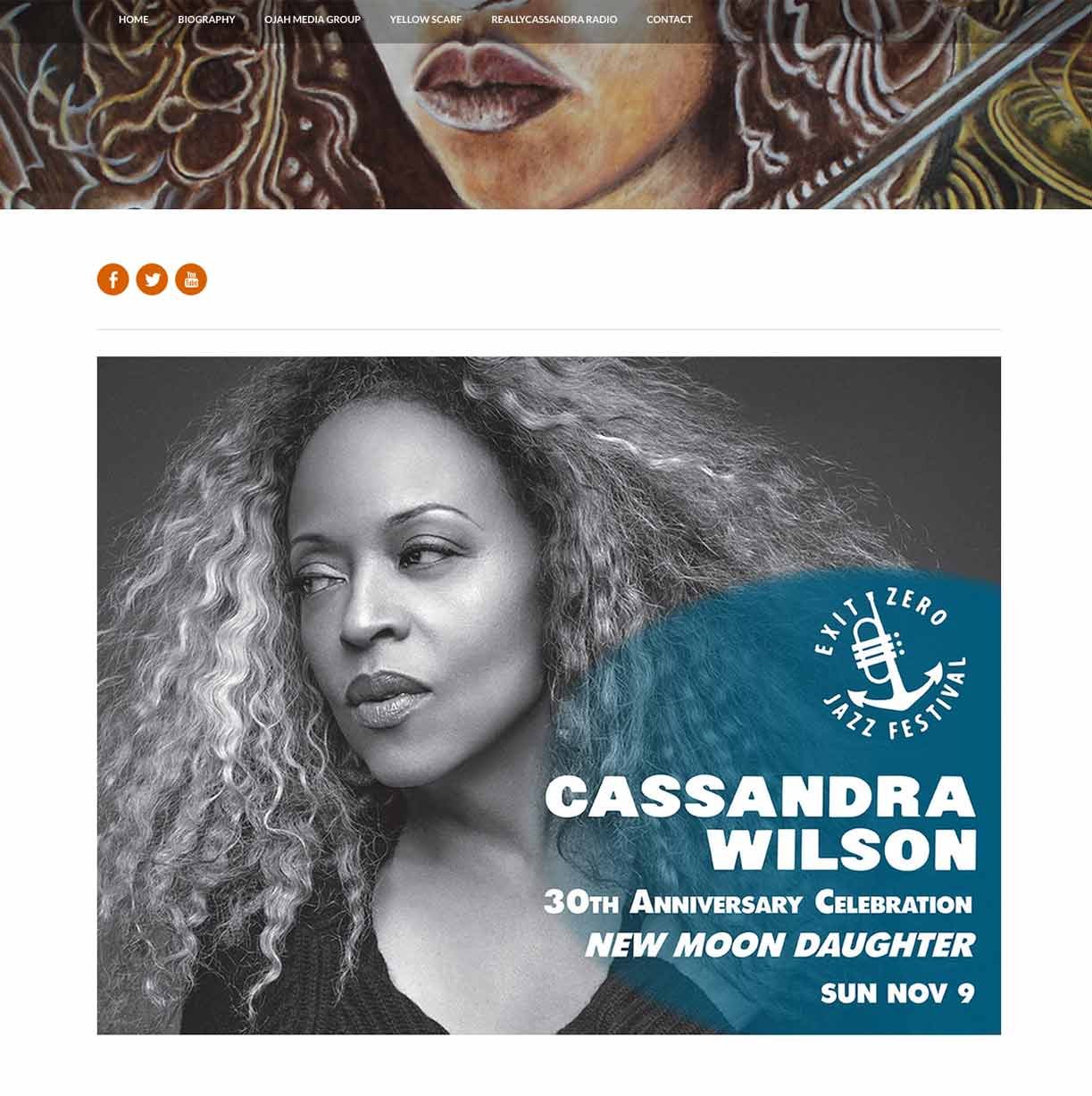
 Some voices enter your life quietly, almost without warning, and then remain there for years. Cassandra Wilson had that kind of voice. For those of us who discovered her music far from the United States, her arrival in the mid 1980s was more than the appearance of another gifted jazz singer. There was something immediately different about her, something that was difficult to explain at first but impossible to ignore. At a time when radio was filled with accomplished female singers, many of them with beautiful voices and remarkable technique, Wilson seemed to come from somewhere deeper. Her voice was dark, warm and slightly weathered, but what made it unforgettable was the feeling behind it. She never sounded as if she were simply delivering a song. She sounded as if she had lived inside it. When Point of View appeared in 1986, it introduced an artist who was already much more than a vocalist. Wilson was an interpreter in the fullest sense of the word, someone who could take a melody and make it feel personal without ever forcing it to become something it was not.
That quality would remain at the center of everything she did. Cassandra Wilson was a jazz singer, but jazz was never large enough to contain her. Born in Jackson, Mississippi, she grew up in a musical environment where blues, gospel, country, folk, popular music and jazz were not necessarily separate worlds. She began playing piano at 6 and took up guitar at 12, and she was writing music early in her life. Her father was a musician, and the records she heard at home helped give her an unusually broad musical vocabulary. The South was not simply the place where she was born. It became part of the way she listened. She carried Mississippi with her when she eventually moved to New York, and she never lost that connection to the music of the American South, even as she became one of the most sophisticated and adventurous voices in contemporary jazz.
Her move to New York in the early 1980s brought her into a very different musical world. She met saxophonist Steve Coleman and became one of the founding members of the M Base collective, joining a generation of musicians determined to challenge conventional ideas about what jazz could be. This is an important part of Wilson’s story because she was never simply a singer placed in front of a band. She was a musician among musicians. She understood rhythm, harmony, composition and arrangement, and she played guitar as well as sang. That background helped explain the freedom that would become so characteristic of her recordings. Even when her music became more accessible, she never stopped thinking like a musician. She listened carefully to the space around her voice, to the musicians accompanying her and to the possibilities hidden inside a song.
Point of View already contained the beginnings of that approach, but her breakthrough years later would make it much clearer. When she joined Blue Note and released Blue Light ‘Til Dawn in 1993, Wilson began to redefine what a modern jazz singer could be. She was not interested in choosing between jazz and the rest of American music. She wanted to hear what happened when the traditions were allowed to speak to one another. Blues could sit beside folk and country, while a song from outside the jazz canon could suddenly sound completely natural in her hands. She could approach the music of Robert Johnson, Bob Dylan or Neil Young without trying to disguise its origins, and she could return to jazz standards without treating them as museum pieces. Her gift was not simply knowing how to sing different kinds of songs. It was knowing how to find the emotional center of each one.
That was perhaps the most remarkable thing about Cassandra Wilson. She did not seem interested in demonstrating how much she could do with her voice. Her singing was rarely about vocal display. Instead, she understood the value of restraint. She knew when to lean into a phrase and when to pull back, when to let a note breathe and when silence could say more than another note. Her dark, grainy timbre could sound almost conversational, yet it carried enormous emotional weight. She did not need to raise her voice to command attention. In fact, some of her most powerful performances were among her quietest. There was always a sense that she trusted the song, trusted the musicians around her and, most importantly, trusted the listener.
Her collaborations with musicians such as Charlie Haden, Bill Frisell, Pat Metheny, Dave Holland, Terence Blanchard and Wynton Marsalis reflected that musical authority. She was respected not only as a singer but as an artist who understood how a recording should breathe. The work she did with producer Craig Street helped establish a sound that became closely associated with her finest recordings: spacious, intimate and textured, with guitars, bass, percussion and silence creating an atmosphere around the voice rather than simply accompanying it. Wilson could make a recording feel close and distant at the same time. Her music left room to listen, room to think and room for the song to unfold without being rushed.
Her success never forced her into a more conventional role. If anything, it gave her the freedom to become more completely herself. She won two Grammy Awards and received numerous honors over the course of a career spanning more than three decades. In 2022, she was named a Jazz Master, one of the highest distinctions in American jazz. Yet none of those achievements quite explains why her music mattered so much to the people who listened to it. Awards belong to history, while voices belong to memory.
For many listeners, Cassandra Wilson will be remembered through moments that have nothing to do with awards or career milestones. It might have been a song heard late at night on the radio, an album discovered by chance, a long drive with her voice filling the car, or a record playing in a quiet room at a particular moment in life. This is how certain musicians become part of us. We do not always remember when they arrived; we simply realize, years later, that they have been there all along. Wilson had that rare ability to become a companion without ever demanding attention. Her music could be deeply present without overwhelming the room.
Her relationship with Billie Holiday offered perhaps the clearest example of her approach to interpretation. On Coming Forth by Day, released in 2015, Wilson returned to Holiday’s repertoire, a daunting challenge for any singer. She did not attempt to imitate Holiday, because imitation would have missed the point. Instead, she approached those songs as a musician who had spent decades learning how to listen. She brought her own history to them, her Mississippi roots, her experience in New York, her years in the avant garde and her deep understanding of the American song. The result was not an exercise in nostalgia but another conversation between past and present. It was a fitting final studio album for an artist who had spent her career proving that honoring tradition does not mean being imprisoned by it.
Mississippi remained at the heart of Wilson’s musical identity, but it would be a mistake to reduce that connection to the familiar story of the singer who came from the birthplace of the blues. Her relationship with the South was more complex than that. It was a memory of sounds and places, of churches and records, of country music and blues, of African American musical traditions and popular songs heard alongside one another. When Wilson moved to New York, she did not leave that world behind. She carried it with her and allowed it to encounter everything she was discovering. That ability to hold different musical histories at once became one of the defining qualities of her work.
Cassandra Wilson leaves behind an extraordinary body of music, but her greatest legacy may be the freedom she represented. She showed that a jazz singer did not have to choose between tradition and originality, between sophistication and emotion, or between the blues and contemporary music. She could belong to all of those worlds without being trapped by any of them. She expanded the idea of what a jazz singer could sound like and, perhaps more importantly, what a jazz singer could listen to. Her music reminded us that American music has never really been a collection of separate boxes. It has always been a conversation.
That is why her death feels like more than the passing of a great singer. Cassandra Wilson was one of those artists whose presence quietly altered the way we heard music. She could take a familiar song and make it feel newly discovered. She could make silence part of a melody. She could sing softly and still leave a lasting impression. For those who first encountered her voice decades ago, the memory of that discovery will remain. There are records we remember because they were important, and there are records we remember because they were there when we needed them. Cassandra Wilson made many of the latter.
Her voice now belongs to the recordings, to the musicians who played beside her and to the generations of listeners who will continue to discover her. But listening to Cassandra Wilson was never simply about hearing a beautiful voice. It was about entering a particular emotional space, one that was at once rooted in the American South and open to the entire world. She made music that could feel intimate without being confessional, sophisticated without becoming cold, and deeply connected to tradition without ever sounding trapped by it.
Cassandra Wilson is gone, but the silence she leaves behind will never be complete because her music remains alive in the recordings and in the memories of those who heard her. For those who discovered her decades ago, she will remain part of the soundtrack of our lives; for those discovering her now, she will still sound like an artist speaking with extraordinary clarity and humanity. Perhaps that is the greatest thing a musician can leave behind: not simply a catalogue of work, but the feeling that a voice has accompanied us for a part of our lives and that, whenever we return to the music, something of that presence is still there.
By Thierry De Clemensat
Member, Jazz Journalists Association
Editor-in-Chief, Bayou Blue Radio
U.S. Correspondent – Paris-Move / ABS Magazine