
THE PATIO, WHERE I PREFER TO SIT

I’ll start with the patio, because that is where I prefer to sit at Cafe Malta, even when the Austin heat makes the choice a little less obvious. On this particular late afternoon, the patio is nearly empty. Inside, Texans have taken refuge from the heat in the cool dining room, where conversations overlap with the sound of glasses clinking and the steady movement of the staff. Everything seems to operate with an almost choreographed precision, yet nothing feels mechanical or rushed.
As the sun begins to sink, the atmosphere changes. The heat becomes easier to bear, the patio becomes more inviting, and there is finally a chance to sit outside, take your time and talk without constantly thinking about the temperature. Every now and then, a few words are exchanged with people at neighboring tables. It is a different way of experiencing a restaurant, slower and more open, and it reminds me of certain European evenings when people linger over dinner without paying much attention to the clock.
That evening, Alex is working the patio. He arrives with a smile, we exchange a few words, and the first drinks soon follow. Then comes the dish I had been waiting to try for several weeks: the steak-frites. By then, I had started to take missing it almost personally. Every time Cafe Malta offered steak-frites, we happened not to be there. After missing it several times, I had developed a genuine desire to finally taste it, so when the plates arrived that evening, there was a certain satisfaction in knowing that I had finally made it on the right night.
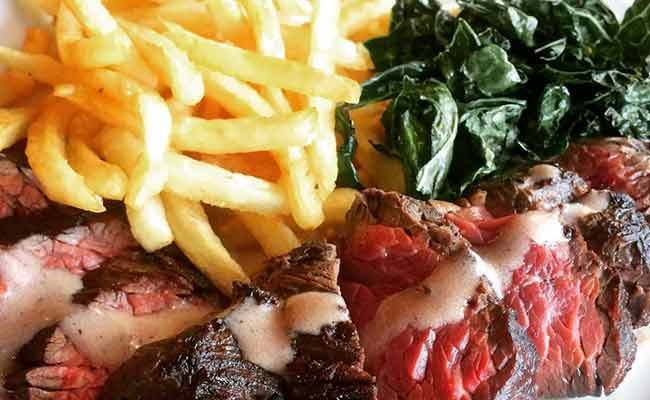
I look at the steak first. It is already sliced, which I personally prefer, and the cooking is exactly what I had hoped for, nicely grilled on the outside and rare in the center. The meat is well seasoned and juicy, but what matters most to me is that it still tastes like beef. A good steak does not need much explanation. It needs good meat, proper seasoning and careful cooking, and this one delivers on all three. Even before taking the first bite, the aroma coming from the plate has already begun to make the case for it.
Then I turn to the fries, because I am fairly demanding when it comes to fries. They should be crisp without being dry, golden without being greasy, and substantial without becoming heavy. At Cafe Malta, they are cooked twice, as is common in Belgium and in other European traditions. The result works very well. They are crisp on the outside, softer inside and light enough that they never overwhelm the steak or the sauce.
And then there is the cognac sauce, which gives the dish another layer without taking over. It has enough presence to complement the beef while allowing the meat to remain the focus. The cognac adds warmth and depth, and the combination works particularly well with the steak. As I eat, I find myself doing something I often do when I enjoy a dish: I start imagining where it could go next. A green peppercorn sauce, a Madeira sauce or a few porcini mushrooms could all take the same basic preparation in another direction. I do not mean that as a criticism. Quite the opposite. When a dish makes you think about other possibilities, it usually means that its foundation is strong enough to inspire them.
A BRASSERIE CLASSIC IN TEXAS
What interests me about this plate is the journey it has taken. Steak-frites is a dish I know, as do many Europeans. It belongs to the tradition of the brasserie, where food is not supposed to be complicated or overly self-conscious. A few good ingredients, proper cooking and a sauce are often enough. But eating steak-frites in Austin inevitably gives the dish another meaning, because beef is hardly foreign here. In Texas, it is one of the products most deeply embedded in the local food culture. What changes is the way the meat is treated and what surrounds it on the plate.
That is what I find interesting about Cafe Malta. I do not see it as an attempt to recreate Paris in Austin, and I am glad it does not feel that way. Austin has its own identity and its own food culture, and there would be little point in pretending otherwise. Instead, Cafe Malta takes Mediterranean and European references and allows them to exist naturally within a Texas setting. The steak-frites becomes a meeting point between different culinary traditions. The beef immediately brings me back to Texas, while the cooking, the fries and the sauce take me back toward Europe. The dish belongs entirely to neither place, and that is part of what gives it character.
I have always appreciated restaurants that know how to let food travel without trying to tell the customer exactly what that journey is supposed to mean. They provide enough references for your own memory and imagination to take over. At Cafe Malta, those references are everywhere. The cooking draws from different Mediterranean traditions, and Lebanese, Italian, French and other influences can appear around the same table. A combination like that could easily feel artificial, but here it feels natural to me because it reflects the way cuisines have always developed: through movement, exchange and adaptation.
The wine can extend that conversation. With this steak, I could easily imagine a Lebanese white such as Anna Beyrouth, which would take the meal in one direction. A Côtes-du-Rhône would create another kind of pairing, while a Negroamaro Salice could move the experience toward southern Italy. I do not feel the need to choose one origin over another, and that is precisely what I enjoy. A single dish can carry several stories depending on what is poured into the glass and which memories that combination happens to bring back.
That ability of food to travel is also one of the things I find most interesting about cooking in general. Recipes do not remain completely fixed. They cross borders, adapt to local ingredients and habits, and eventually become part of more than one place. Steak-frites is a simple example. The steak can evoke Texas, the fries can bring Brussels to mind, and the cognac sauce adds another distinctly European reference. Once all of those elements come together in Austin, however, the dish becomes something of its own. It belongs to the place where it is being served as much as it belongs to the traditions that inspired it.
WHAT I WILL REMEMBER
If I think back on that evening, however, I realize that the steak is not the only thing I remember. A restaurant is never entirely about its food. There is the service, the light, the sound of the room, the people around you and, perhaps most importantly, the amount of time you allow yourself to spend there. There is also that difficult-to-define feeling of being comfortable at a table and not wanting the evening to end too quickly.
At Cafe Malta, the patio contributes a great deal to that feeling. I like it precisely because it is not trying to be spectacular. It simply gives you a place to remain outside as the Austin heat begins to fade. You order a drink, you talk, you look around and the evening gradually takes shape without any particular need to hurry. This is probably where I feel the Mediterranean spirit of the restaurant most clearly, not only in the food but in its relationship with time. The meal stops being a break between two activities and becomes an activity in itself.
By the time the steak arrived, that atmosphere had already become part of the experience. I had wanted this dish for several weeks and had missed it more than once, so I knew exactly what I was hoping to find: properly cooked beef, fries worthy of the name and a sauce with enough personality to make the plate memorable. I was not disappointed. In fact, I would say that it is one of the more interesting steak-frites plates I have had in Austin, not because it is extravagant or particularly showy, but because it manages to remain simple while suggesting something beyond itself.
What stays with me most is Cafe Malta’s ability to create a place where several culinary cultures can meet without one having to erase the others. The restaurant does not try to make me believe that I am in Paris, nor does it try to turn its steak-frites into a showcase of Texas cooking. Instead, it brings back certain flavors and memories while giving them another life in Austin. That distance is what I enjoy most about it: finding something familiar in a place that is not entirely familiar.
I will come back for the steak-frites, of course, but not only for the steak-frites. I will come back for the patio, for those late Austin afternoons when the heat finally begins to soften, for a drink before dinner and for the pleasure of letting an evening unfold without having to rush it. And now that I have finally managed to be there on the night steak-frites was being served, I certainly do not intend to wait quite so long before having it again. The next time, at least, I will know exactly what I am coming for.