
Summary: In Timestamp, poet, artist, and record producer David Breskin transforms 105 days of daily writing into a provocative poetic chronicle of contemporary life. Blending dark humor, political critique, striking imagery, and reflections on nature and technology, Breskin explores the contradictions of human ambition and the fragility of existence. From billionaire excess and environmental destruction to intimate moments of parental anxiety, Timestamp reveals a world in which the more humanity seeks to control, the less it seems to understand. An inventive and uncompromising work, the collection offers a compelling portrait of modern American society through the lens of poetry and imagination.
Description: Explore David Breskin’s Timestamp, a daring collection of daily poems examining politics, technology, ecological anxiety, human vulnerability, and the absurdities of modern life.
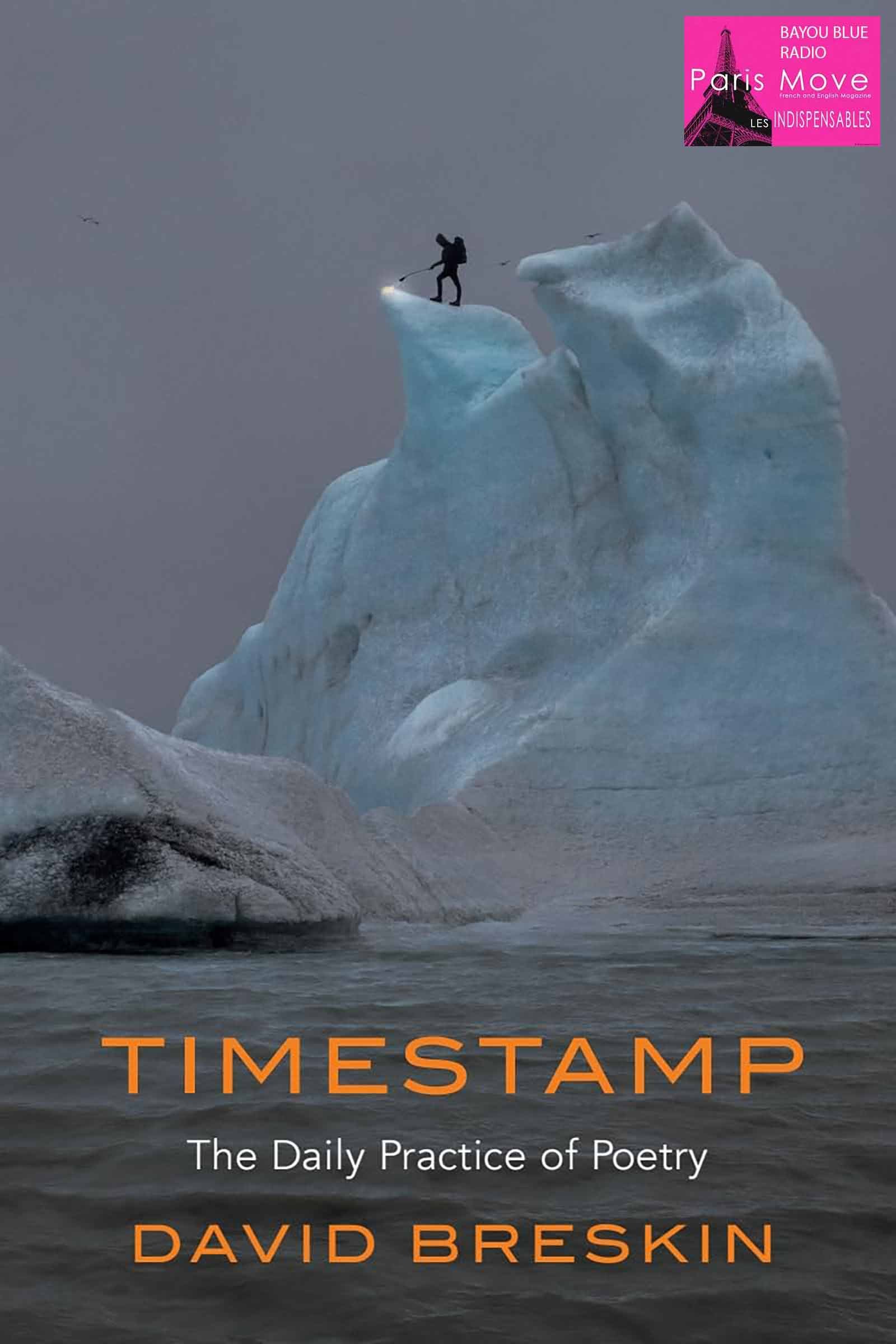
Avant-garde poet, artist and record producer David Breskin’s new volume, Timestamp, is the record of one man’s thoughts over 105 days, in one poem per day, “timestamped” with day and hour then emailed (and often dedicated) to a targeted reader. An exercise of discipline and fortitude after an eight-year dry spell (since his previous book, Campaign, about the 2016 election) one might imagine it a series of either news-inspired flashbacks, or more personal musings. It is neither, and both.
The poems span between August 11, 2024, and February 24, 2025. While wondering if I was about to release a Pandora’s box of collective trauma into my overworked brain, I opened this volume at the middle, and my eyes immediately fell upon a verse about Elon Musk and his nether parts. Laughing, I knew it would be a wild ride.
Breskin’s timestamps are fun, intimate, wide-sweeping, and fraught with danger. Day by day, Breskin reveals an epic truth: the more we know, the less we understand. Our will to master the universe inevitably reveals our mastery of less than nothing.
Stark beauty contrasts with despair. “Extremes and In-betweens” (August 23), dedicated to Ed Ruscha, reads like a strip of Ruscha road populated with oil wells and data centers, concluding with the line:
“your name on the list, ‘cause from here on you’ll be running up the down escalator.”
Throughout these scenes of human angst comes a measure of sardonic self-reflection:
“Placeholder” (August 26) reminds us, “Today is just tomorrow’s compost,” while “Try Not” (August 27) exhorts, “Try not to think about thinking too much.”
In frequent contrast to bleak, human-made systems, the animals come out ahead in spite of many pointed attempts to destroy nature throughout. Breskin gives us large-scale analysis in bite-sized portions.
Piping Plover uninfected by thoughts of Sisyphus protect their offspring (“Broken Wing Display,” August 20); and meanwhile, a billionaire and his family, victims of Bayesian self-myth, drown in the Mediterranean (The Billionaire & The Waterspout, August 24). Animals drift in and out of the picture, unconcerned by all the human angst and ego on display. A wizened sea turtle creates a soothing parenthesis in the middle of a human biological ticking time display (“Clock Face,” August 28). Dogs frequently steal the show.
And this is just August. These themes continue throughout; the animals seem to grow stronger and the billionaires more amoral, weakening our resolve with technology.
Flash forward to January 3, featuring “The Elephant Seal & The Picket Fence,” where “the Beachmaster” bull seal protagonist dominates all in its path with more brute force than any of the human bullies on display:
“In this scenario, the picket fence
represents the dim simplicity of
human thought. The woke Beachmaster would no
sooner destroy it than he would build it.”
Human vulnerability is Timestamp’s standout theme, whether engulfed by nature, technology, or corporations. One expects the poet to touch upon universal truths but it always comes as a shock when the illusions strike personally, as do these verses about a child traveling unaccompanied, where we are instantly transported into the thoughts of a parent watching a child disappear into an airport security line. “He’s Gone” (September 1) is a punch in the gut:
“When a child disappears into the open jaw
of airport does it much matter how old he is?
He might be eight with a bright lanyard round his neck
(….)
He goes and doesn’t look back. The answer is No.”
Potential for catastrophe lurks around every corner. The beat-style “Letter to Julian Charriere in Berlin” (November 17) muses on the death of cool, if not the entire planet:
“Swing states no longer play Count Basie, Duke Ellington, Fletcher Henderson, Benny Goodman or Prez. We’ve plowed the optimistic music under. Rare earth metals quiver in abandoned mines and uranium’s in heat again, lusting for that big shovel.”
It makes one dream of escaping that crass American noise. Art from chaos… Explosions of words on a paper canvas…
Or as the author states himself, “Cry me atmospheric river.” (“Bombogenesis,” November 18, 2024)
This book is an atmospheric river, a dream of imagination for everyone who paints a picture in their heads, and its strongest points of view are in its visceral, individual glimpses of humanity. Another beat-style letter, this time to Spencer Glendon in Boston (November 19), flashed me back mentally to Frida Kahlo’s “A Broken Column:”
“When we were walking that February
cemetery, you told me if they had
to open you up again they’d find a
smorgasbord of organs encased in poured
concrete. Let’s keep the jackhammer closet
locked and your wide chest-to-belly YKK
flesh zipper stitched shut.”
Like the best art-house cinema, Breskin’s imagery lingers in the mind, growing stronger with time.
Ilene Martinez-Clemensat
Singer-songwriter, journalist
ilene-martinez.com