
Influence, Power and the Unanswered Questions
An Investigative Report on Jeffrey Epstein’s French Network
Executive Summary
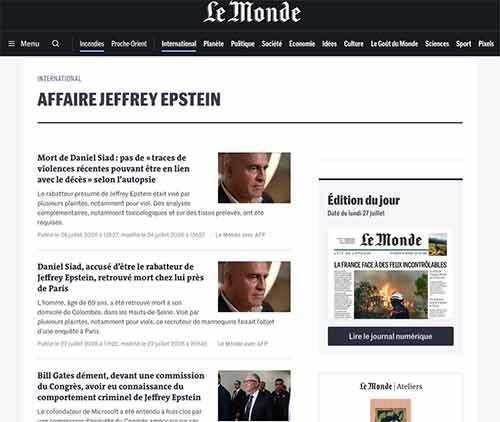 A Network of Influence, Access and Unanswered Questions
The Jeffrey Epstein affair has become one of the most complex international scandals of the modern era. Initially centered on Epstein’s criminal activities in the United States, the investigation has progressively revealed a much broader network of relationships extending into Europe, including France.
The French dimension of the case raises fundamental questions about the mechanisms of influence, the role of personal recommendations among elites, and the ability of institutions to identify and respond to individuals who use social credibility to gain access to powerful circles.
The central question of this investigation is not simply:
“Who met Jeffrey Epstein?”
A relationship, a meeting, an invitation, or an appearance in a contact list does not by itself establish criminal involvement.
The more important question is:
How was Jeffrey Epstein able to build and maintain access to influential networks despite serious allegations and a previous criminal conviction?
This investigation examines the documented elements of Epstein’s French network, the individuals connected to it, the judicial investigations that followed, and the broader institutional questions raised by the case.
Methodology and Sources
This report follows several principles:
- Separation between facts and interpretation
Each element is categorized according to its status:
Documented fact
Information supported by official documents, court records, public statements, or reliable journalistic reporting.
Reported allegation
Claims published by credible sources but not established by a court.
Ongoing investigation
Matters currently examined by judicial authorities.
Analysis
Interpretation of broader patterns based on available evidence.
- Presumption of innocence
Being mentioned in:
- emails
- calendars
- address books
- flight records
- photographs
- correspondence
does not automatically indicate criminal conduct.
Investigations must determine whether relationships were social, professional, financial, or criminal.
That distinction is essential.
- Sources
The investigation relies primarily on:
France Info
Mathilde Texier’s investigation:
“Comment Jeffrey Epstein a multiplié les voyages et les rencontres à Paris pour étendre son réseau d’influence.”
Le Monde
Reporting on French figures connected to Epstein-related documents and investigations.
Reuters
International reporting on:
- Jean-Luc Brunel
- Daniel Siad
- French judicial developments
BBC News
Reporting on Jean-Luc Brunel and the international investigation.
Associated Press
International coverage of French developments.
Miami Herald
The investigative reporting by Julie K. Brown that helped reopen public attention on Epstein’s crimes.
https://www.miamiherald.com/news/local/article220097825.html
Chapter 1
Jeffrey Epstein’s French Network
Paris: A Strategic Location
Paris was not simply another stop in Jeffrey Epstein’s international travels.
According to French media investigations, including France Info’s reporting, Paris represented an important location where Epstein developed relationships with individuals from influential sectors.
The city offered several advantages:
- international financial institutions
- diplomatic circles
- cultural prestige
- scientific institutions
- luxury networks
- proximity to European elites
For someone seeking social legitimacy, Paris provided an environment where cultural reputation and personal connections could create significant access.
The Avenue Foch Residence
One of the most significant elements of Epstein’s French presence was his apartment located on Avenue Foch in Paris.
The address itself carried symbolic importance.
Avenue Foch is among the most prestigious residential areas in Paris, historically associated with political, financial and international elites.
Properties in such locations are not simply residences.
They can function as social platforms.
Private dinners, meetings and introductions occurring in prestigious environments often carry an implicit message:
This person belongs here.
For Epstein, creating that perception was a central element of his strategy.
The Architecture of Influence
Epstein’s method was not based primarily on public visibility.
It was based on access.
The pattern identified by journalists across several countries was consistent:
- Identify influential individuals.
- Obtain an introduction through someone trusted.
- Establish credibility through association.
- Expand the network through additional recommendations.
This approach relies on a fundamental principle of elite networks:
Trust is often transferred through relationships.
If a respected scientist, banker, politician or cultural figure introduces someone, others may assume that person has already been vetted.
This mechanism can accelerate opportunities.
It can also create vulnerabilities.
The Role of Intermediaries
The France Info investigation highlights the importance of intermediaries in Epstein’s Paris network.
Rather than approaching every influential person directly, Epstein often benefited from people who could open doors.
This does not mean intermediaries necessarily knew the full extent of Epstein’s criminal activities.
That distinction is critical.
A person can introduce someone without knowing their private behavior.
However, from an investigative perspective, understanding these introductions helps explain how Epstein maintained access despite his controversial history.
After 2008: The Critical Question
One of the most difficult questions surrounding Epstein’s international relationships concerns the period after his 2008 conviction in Florida.
By that point, Epstein had already pleaded guilty to soliciting prostitution from a minor.
The question raised by investigators and journalists is:
Why did some relationships continue afterward?
There are several possible explanations:
- some individuals may not have known the details;
- some may have underestimated the seriousness of the conviction;
- some may have relied on Epstein’s explanations;
- some may have valued the relationship despite warning signs.
Determining which explanation applies requires evidence in each individual case.
The French Question
The French dimension of the Epstein affair therefore raises a broader issue.
Not simply:
“Who was connected to Epstein?”
But:
“How do systems of influence allow individuals with serious allegations against them to continue accessing elite environments?”
This question extends beyond Epstein.
It concerns:
- reputation management;
- social networks;
- institutional due diligence;
- the responsibility of influential individuals;
- transparency.
THE FRENCH BRANCH OF THE EPSTEIN AFFAIR
Chapter 2 — The Fashion Connection
Jean-Luc Brunel, Modeling Networks and the First Major French Link to Epstein
Introduction
Among all French individuals connected to Jeffrey Epstein, Jean-Luc Brunel remains one of the most significant figures.
His name appears repeatedly throughout investigations into Epstein’s international activities because of the role he played in the fashion industry and because of allegations that he used his position within modeling networks to identify and recruit young women.
Unlike many other figures associated with Epstein, Brunel was not merely a social contact.
He was considered by investigators to be a potential key witness who could provide information about how Epstein’s network operated.
His death in 2022, before any trial could take place, left many questions unanswered.
However, as with all aspects of this investigation, it is essential to distinguish between:
- documented facts;
- allegations made by witnesses or investigators;
- judicial findings;
- unanswered questions.
- Jean-Luc Brunel: A Powerful Figure in Fashion
Jean-Luc Brunel was one of France’s most prominent modeling agents.
During the 1980s and 1990s, he became internationally known through his agency Karin Models, which represented numerous young models seeking careers in the fashion industry.
His reputation placed him at the center of an industry where relationships, personal recommendations and access played a crucial role.
Fashion, like many elite sectors, relies heavily on networks.
Agents act as intermediaries between young talent and powerful clients:
- photographers;
- designers;
- magazines;
- advertising agencies;
- international brands.
This position gives agencies considerable influence over young people attempting to enter the industry.
It was precisely this position of influence that later attracted scrutiny.
- The Creation of MC2 Model Management
In the mid 2000s, Brunel became associated with Jeffrey Epstein through the creation of MC2 Model Management.
The company operated in the United States and was presented as a high-end modeling agency.
Epstein provided financial backing for the company.
The exact nature of the business relationship between Epstein and Brunel has been examined by journalists and investigators because it represented one of the clearest professional links between Epstein and the fashion world.
The partnership raised questions about:
- Epstein’s financial involvement;
- Brunel’s access to young models;
- the purpose of the agency;
- whether the company was used for legitimate business activities or something more problematic.
Those questions became central after allegations against Epstein became public.
- Allegations Against Brunel
Over several years, multiple women accused Jean-Luc Brunel of inappropriate behavior and involvement in Epstein’s activities.
Some accusers alleged that Brunel recruited young women and introduced them to Epstein.
These allegations were investigated by authorities in France and the United States.
Brunel denied wrongdoing.
He repeatedly rejected accusations that he participated in criminal activity.
It is important to note:
No French court convicted Jean-Luc Brunel of the allegations against him before his death.
The judicial process ended without a final verdict because the accused was no longer alive to face trial.
- The French Investigation
Following the arrest and later death of Jeffrey Epstein in 2019, French authorities opened investigations into possible crimes committed in France.
The investigation examined allegations including:
- sexual abuse;
- trafficking-related offenses;
- possible recruitment networks.
Jean-Luc Brunel became one of the central figures.
In December 2020, French authorities arrested him.
He was later charged with offenses including:
- rape of a minor over the age of 15;
- sexual harassment;
- involvement in the exploitation of young women.
Brunel denied the accusations.
His lawyers maintained that he was innocent and that he had been unfairly targeted because of his association with Epstein.
- The Death of Jean-Luc Brunel
During the night of February 18 to 19, 2022, Jean-Luc Brunel was found dead in his cell at La Santé Prison in Paris.
Authorities announced that he had died by hanging.
The French investigation concluded that his death was a suicide.
At the time, Brunel was awaiting trial.
His death prevented the court from examining testimony and evidence that might have clarified several unanswered questions.
- Why Brunel’s Death Had Such an Impact
The death of a key suspect before trial inevitably creates uncertainty.
A trial serves several purposes:
- examining evidence;
- questioning witnesses;
- allowing the defense to respond;
- establishing judicial conclusions.
Without a trial, the public is left with incomplete information.
This situation created frustration among:
- alleged victims seeking answers;
- investigators who lost a potential source of information;
- journalists attempting to reconstruct Epstein’s network.
However, the absence of a trial does not mean that allegations are automatically proven.
Nor does it mean that they were unfounded.
It simply means that the judicial process was never completed.
- The Brunel Question: What Did He Know?
One of the central unanswered questions remains:
What exactly was Jean-Luc Brunel’s role in Jeffrey Epstein’s network?
Several possibilities have been discussed:
Possibility 1:
Brunel was primarily a fashion professional whose relationship with Epstein became problematic because Epstein used his connections.
Possibility 2:
Brunel knowingly participated in recruiting young women for Epstein.
Possibility 3:
The reality involved different levels of knowledge and involvement over time.
Only evidence can determine which interpretation is correct.
The death of Brunel means that some answers may never become available.
- The Broader Lesson: Vulnerable Industries and Gatekeepers
Beyond the individuals involved, the Brunel case raises broader questions about industries where young people depend heavily on gatekeepers.
Fashion, entertainment, sports and other sectors often involve:
- young candidates seeking opportunities;
- powerful intermediaries;
- international travel;
- unequal relationships of power.
These environments require strong safeguards.
The Epstein affair demonstrated how influential individuals can exploit reputation and connections to gain access to vulnerable people.
- Sources and References
Reuters
Coverage of Jean-Luc Brunel’s death and the French investigation:
https://www.reuters.com/world/europe/french-model-agent-jean-luc-brunel-found-dead-prison-2022/
BBC News
Background on Brunel and his connection to Epstein:
https://www.bbc.com/news/world-europe-60433658
Miami Herald
Julie K. Brown’s investigation into Jeffrey Epstein and the network surrounding him:
https://www.miamiherald.com/news/local/article220097825.html
French Judicial Reporting
French media coverage of the investigation:
Conclusion
Jean-Luc Brunel represents one of the most important French chapters of the Epstein affair.
His career gave him access to a world where influence, money and personal relationships intersected.
His association with Epstein placed him at the center of one of the most disturbing investigations of recent decades.
Yet the final judicial answers that might have emerged from a trial will never be known.
The Brunel chapter therefore illustrates one of the most difficult aspects of the Epstein investigation:
when key witnesses or suspects disappear before the truth is fully examined in court, society is left with fragments.
The responsibility of investigators and journalists is then greater than ever:
to preserve the distinction between accusation and proof, while continuing to examine the systems that allowed such networks to exist.
THE FRENCH BRANCH OF THE EPSTEIN AFFAIR
Chapter 3 — Building Influence
How Jeffrey Epstein Entered French Political, Financial, Scientific and Cultural Circles
Introduction
The most important lesson from the French dimension of the Epstein affair may not be about any single individual.
It is about how influence works.
Jeffrey Epstein did not become accepted among wealthy and influential circles simply because of his money. Wealth alone rarely provides lasting access to the highest levels of society.
What Epstein cultivated was something more powerful:
credibility through association.
He surrounded himself with respected individuals, supported prestigious institutions, presented himself as a philanthropist, and used introductions from trusted figures to enter circles that would otherwise have remained inaccessible.
The question at the center of this chapter is therefore not:
“Who met Jeffrey Epstein?”
The more significant question is:
“How did Jeffrey Epstein create an environment in which so many influential people were willing to meet him?”
- The Power of an Introduction
According to the investigation by France Info journalist Mathilde Texier, Epstein’s approach in France relied heavily on recommendations.
He understood an essential rule of elite networks:
Access is usually granted through trust.
A person introduced by a respected intermediary benefits from a form of social approval before the first meeting even takes place.
The logic is simple:
“If someone I respect trusts this person, perhaps I can trust them as well.”
This mechanism exists in many sectors:
- politics;
- banking;
- science;
- universities;
- philanthropy;
- culture;
- business.
It is not inherently negative.
In fact, professional networks depend on it.
However, it can also create blind spots.
A recommendation may replace independent verification.
A prestigious contact may unintentionally provide legitimacy to someone who does not deserve it.
- Epstein’s Strategy: Becoming “Acceptable”
After his 2008 conviction in Florida, Epstein faced a serious reputational challenge.
A convicted sex offender would normally be expected to lose access to elite circles.
Yet investigations have shown that Epstein continued maintaining relationships with influential individuals in several countries.
How was this possible?
Several elements appear repeatedly in reporting:
Financial Resources
Epstein presented himself as an extremely wealthy financier.
His money allowed him to participate in elite environments where wealth often functions as a form of credibility.
Philanthropic Image
Epstein associated himself with scientific and cultural initiatives.
He cultivated relationships with researchers, universities and charitable organizations.
This created the image of someone interested in supporting intellectual and social causes.
Social Proof
Perhaps the most important element was association.
When respected individuals appeared comfortable with Epstein, others were more likely to assume that he was legitimate.
This phenomenon is sometimes described as social proof:
people judge a person based on the acceptance they receive from others.
- Paris as an Influence Network
Paris represented an especially favorable environment for Epstein’s strategy.
The French capital combines several worlds that rarely exist separately elsewhere:
- international finance;
- diplomacy;
- luxury industries;
- academic institutions;
- cultural organizations;
- political networks.
These communities overlap.
A person connected to one sector can quickly gain access to another.
A banker may know a museum director.
A scientist may know a philanthropist.
A politician may know business leaders.
This interconnected structure creates opportunities for influence.
- The French Elite Network
France, like many countries, has long been characterized by networks built through:
- elite schools;
- professional organizations;
- family connections;
- cultural institutions;
- political relationships.
These networks can be valuable.
They allow cooperation, expertise sharing and the development of important projects.
But they can also create closed circles where personal reputation matters more than external scrutiny.
This does not mean that all elite networks are corrupt.
It means that strong networks require strong accountability.
- The Scientific and Academic World
One of Epstein’s most effective strategies internationally was his relationship with scientific institutions.
He positioned himself as a supporter of research.
His donations and connections allowed him access to prominent scientists and universities.
This created another layer of legitimacy.
A person associated with respected academic institutions often benefits from an assumption of credibility.
However, later revelations about Epstein forced many institutions to examine whether they had performed sufficient due diligence.
The broader question became:
Should institutions investigate the origins and reputation of major donors more carefully?
- Political Connections
The Epstein affair has inevitably attracted political attention because influence networks often overlap with politics.
France is no exception.
However, a crucial distinction must be maintained.
Meeting a political figure does not prove:
- corruption;
- participation in crimes;
- knowledge of criminal activity.
Political figures regularly meet thousands of people during their careers.
The relevant questions are:
- What was the nature of the relationship?
- When did it occur?
- What information was known at the time?
- Were any laws broken?
Only evidence can answer those questions.
- Jack Lang: The Importance of Context
Jack Lang became one of the most discussed French figures after documents and reporting connected him to Epstein-related investigations.
However, understanding this issue requires separating several elements:
Documented
- Epstein and Jack Lang knew each other.
- Their relationship has been reported by French media.
- Financial questions involving entities connected to Lang’s family have been investigated.
Not established
- That social contact automatically represented criminal involvement.
- That every person associated with Epstein was aware of his crimes.
The investigation must therefore focus on evidence rather than association.
This principle applies to every person named in Epstein-related documents.
- The Role of Intermediaries
One of the most important themes emerging from the French investigation is the role of people who opened doors.
Influence networks often depend less on direct access and more on intermediaries.
A person with credibility in one field can introduce someone into another.
This creates a chain:
Epstein → intermediary → influential person → wider network
The intermediary may not know the complete reality of the person they introduce.
However, their reputation provides access.
This is why investigators study not only individuals but also the architecture of relationships.
- Why Networks Matter More Than Individual Meetings
A common misunderstanding in discussions about Epstein is focusing exclusively on individual encounters.
One dinner.
One photograph.
One meeting.
One email.
But influence networks are not built through isolated events.
They are built through accumulation.
Hundreds of small interactions can create a perception of legitimacy.
A person appears everywhere because many respected people appear around them.
That perception can become self-reinforcing.
- The Due Diligence Question
The Epstein case raises a broader institutional question:
How much responsibility do organizations and influential individuals have to investigate the people they associate with?
There is no simple answer.
A private individual cannot investigate every person they meet.
However, institutions handling:
- large donations;
- political influence;
- scientific funding;
- public trust;
have a greater responsibility.
The question is not whether every association should be avoided.
The question is whether reasonable verification took place.
Conclusion
The French branch of the Epstein affair reveals the mechanics of influence.
Jeffrey Epstein’s power did not come only from money.
It came from access.
Access created reputation.
Reputation created more access.
This cycle allowed him to maintain relationships with influential circles even after serious allegations had emerged.
The central lesson is not that every person who crossed paths with Epstein was involved in his crimes.
The evidence does not support such a conclusion.
The deeper lesson is about how modern societies organize trust.
When reputation replaces verification, when personal recommendations replace scrutiny, and when influence becomes concentrated within closed networks, vulnerabilities appear.
The Epstein affair therefore raises a question that extends far beyond one individual:
How can democratic societies preserve the benefits of networks while preventing those networks from becoming shields against accountability?
Sources
France Info
Mathilde Texier
“Comment Jeffrey Epstein a multiplié les voyages et les rencontres à Paris pour étendre son réseau d’influence.”
Le Monde
Coverage of French connections and investigations:
Miami Herald
Julie K. Brown’s investigation:
https://www.miamiherald.com/news/local/article220097825.html
THE FRENCH BRANCH OF THE EPSTEIN AFFAIR
Chapter 4 — Jack Lang
A Former Minister, Epstein-Related Documents and the Question of Financial Transparency
Introduction
Among French public figures connected to Jeffrey Epstein, few cases have attracted as much attention as that of Jack Lang.
The former French Minister of Culture under President François Mitterrand, longtime political figure, and president of the Institut du monde arabe became the focus of public debate after documents released in the United States and subsequent investigations by French media revealed a previously documented relationship between Epstein, Lang, and members of his family. (Le Monde.fr)
The case illustrates one of the central difficulties of the Epstein investigation:
The difference between a documented relationship and criminal responsibility.
Meeting Epstein, corresponding with him, receiving assistance, or appearing in released documents does not automatically establish participation in Epstein’s crimes.
However, when relationships involve financial arrangements, companies, gifts, or significant benefits, they naturally raise questions requiring examination.
This chapter focuses on what has been reported, what is documented, what has been investigated, and what remains unresolved.
- Jack Lang: A Major Figure in French Public Life
Jack Lang has been one of the most recognizable figures in French political and cultural life for more than four decades.
He served as:
- Minister of Culture under François Mitterrand;
- Minister of Education;
- Member of Parliament;
- President of the Institut du monde arabe.
His influence extended beyond politics.
He became known internationally through his involvement in cultural diplomacy, artistic initiatives, and international exchanges.
It was partly through these cultural networks that his relationship with Jeffrey Epstein developed.
- The Beginning of the Relationship
According to reporting by Le Monde, Jack Lang acknowledged knowing Jeffrey Epstein and meeting him several times.
Lang described Epstein as a businessman interested in art and culture and stated that he did not know the full extent of Epstein’s criminal activities at the time of their relationship. (Le Monde.fr)
This point is central.
The existence of a relationship is documented.
The question is not whether Epstein and Lang knew each other.
The question is:
What was the nature and significance of that relationship?
- The Epstein Files and French Public Figures
The publication of additional Epstein-related documents in the United States brought renewed attention to several French personalities.
The documents included:
- emails;
- correspondence;
- business-related material;
- references to meetings and contacts.
However, the presence of a person’s name in the Epstein Files does not, by itself, prove criminal conduct.
Large document releases often contain thousands of names connected in different ways:
- direct contacts;
- professional relationships;
- social acquaintances;
- administrative references.
Each connection requires individual examination.
- Caroline Lang and Prytanee LLC
The most significant element of the Lang investigation concerns Prytanee LLC, an offshore company registered in the U.S. Virgin Islands in 2016.
According to reporting by Le Monde, the company was created by Jeffrey Epstein and Caroline Lang, Jack Lang’s daughter. The stated purpose involved acquiring and investing in artwork. (Le Monde.fr)
The reported structure raised questions because:
- Epstein provided the financial capital;
- Caroline Lang held shares in the company;
- the project involved future art investments and potential profits.
According to Caroline Lang’s statements reported by Le Monde, she did not invest personal money into the company and said she never received funds from it. She described her involvement as a mistake in judgment and said she should have exercised greater caution. (Le Monde.fr)
- The Art Investment Project
The project reportedly involved Epstein contributing funds for an art investment structure.
According to Le Monde, correspondence described plans involving the acquisition of artworks and possible resale, with profits intended to be shared. (Le Monde.fr)
This aspect became controversial because Epstein’s financial role was significant.
The central questions raised by investigators include:
- Why did Epstein finance such a project?
- What was the intended purpose?
- Were all legal and tax obligations respected?
- Did all parties fully understand the structure?
These are financial and governance questions.
They are separate from allegations concerning Epstein’s sexual crimes.
- The Question of Due Diligence
The Lang case raises a broader issue that appears throughout the Epstein affair:
How thoroughly did influential individuals verify Epstein’s background before entering relationships with him?
By 2016, Epstein’s 2008 conviction in Florida was publicly known.
This creates an important question:
Did individuals and institutions reassess their relationships with Epstein after that conviction?
Different people connected to Epstein have provided different explanations:
- some said they were unaware of details;
- some believed the matter had been resolved;
- some later acknowledged poor judgment.
The answer depends on the facts of each individual relationship.
- Financial Transparency and Public Trust
The controversy surrounding Jack Lang has focused largely on transparency.
In democratic societies, public figures are held to higher standards because their credibility depends partly on public confidence.
Even when conduct is not criminal, questions may arise concerning:
- judgment;
- disclosure;
- conflicts of interest;
- institutional reputation.
For public figures, transparency often becomes as important as legality.
- Judicial and Investigative Status
French authorities have examined financial aspects connected to the Epstein-related documents and relationships.
Media reports have described investigations concerning financial matters involving individuals connected to these files. (Le Monde.fr)
However, an investigation does not mean guilt.
A judicial inquiry exists precisely because authorities are seeking to determine whether legal violations occurred.
The outcome must come from evidence and judicial proceedings.
- What Is Established
Based on published reporting:
Documented
✔ Jack Lang knew Jeffrey Epstein.
✔ Their relationship lasted several years.
✔ Caroline Lang was involved in Prytanee LLC with Epstein.
✔ Financial questions surrounding the structure have been investigated.
✔ Correspondence between Epstein and members of the Lang family exists. (Le Monde.fr)
- What Has Not Been Established
At this stage:
✘ A relationship with Epstein alone does not establish criminal participation.
✘ Appearing in documents does not automatically indicate wrongdoing.
✘ Social or financial links must be examined individually.
✘ Allegations must be proven through judicial processes.
This distinction is essential.
Without it, investigative reporting risks becoming accusation by association.
- The Broader Meaning of the Lang Case
The importance of the Jack Lang case extends beyond one individual.
It illustrates a recurring theme of the Epstein affair:
How do powerful networks evaluate trust?
Epstein benefited from being perceived as legitimate.
That perception was reinforced by his connections.
The Lang case therefore contributes to a larger discussion about:
- elite networks;
- financial transparency;
- reputation management;
- institutional responsibility.
Conclusion
The Jack Lang chapter is one of the most politically sensitive parts of the French Epstein investigation.
The available evidence demonstrates a documented relationship between Epstein and members of the Lang family, including a financial structure involving Caroline Lang and Prytanee LLC.
Those facts justify investigation and public scrutiny.
However, responsible analysis requires a clear distinction between:
- association;
- poor judgment;
- financial questions;
- proven criminal conduct.
The Epstein affair demonstrates how difficult it can be to separate influence networks from accountability.
The ultimate responsibility remains with investigators and courts: to determine whether any laws were broken.
The responsibility of journalism is different:
to examine the evidence carefully, ask difficult questions, and avoid replacing proof with assumption.
References
Le Monde
“Epstein case: Sex offender’s correspondence implicates French public figures”
(Le Monde.fr)
“How the Epstein scandal brought down Jack Lang”
(Le Monde.fr)
“Comment l’affaire Epstein a fini par faire chuter Jack Lang”
(Le Monde.fr)
THE FRENCH BRANCH OF THE EPSTEIN AFFAIR
Chapter 5 — Caroline Lang
Prytanee LLC, Art, Offshore Structures and the Financial Questions Raised by the Epstein Files
Introduction
The financial dimension of the Epstein affair is one of the most complex aspects of the investigation.
Unlike criminal allegations involving direct victims, financial relationships often involve structures that are technically legal but may raise questions about transparency, purpose, and accountability.
The case involving Caroline Lang, daughter of former French Minister of Culture Jack Lang, has attracted attention because it combines several elements that frequently appear in investigations involving wealthy individuals:
- offshore corporate structures;
- private investment projects;
- art transactions;
- relationships between wealthy financiers and cultural networks.
The central issue is not simply that a company existed.
The important questions are:
Why was the company created?
Who provided the money?
Who benefited from the arrangement?
Was everything properly declared and managed?
- The Creation of Prytanee LLC
According to reporting by Le Monde, Prytanee LLC was created in 2016 in the U.S. Virgin Islands.
The company involved:
- Jeffrey Epstein;
- Caroline Lang.
The stated objective was connected to art investment.
Epstein provided the financial resources, while Caroline Lang was associated with the project as a partner.
The use of an offshore company immediately attracted attention because offshore structures are often associated in public debate with secrecy and tax avoidance.
However, an important distinction must be made:
An offshore company is not automatically illegal.
International businesses, investment funds, and legitimate financial structures frequently use companies registered in different jurisdictions.
The relevant questions concern:
- transparency;
- declared ownership;
- tax compliance;
- the purpose of the structure;
- movement of funds.
- Why the Art Sector?
The choice of art as an investment field is significant.
The international art market has several characteristics that make it attractive to wealthy investors:
- high-value transactions;
- international mobility;
- subjective valuations;
- private sales;
- limited public pricing information.
Art can be a legitimate investment.
However, because of its characteristics, it has also historically attracted scrutiny from financial investigators studying:
- money laundering;
- hidden ownership;
- conflicts of interest.
This does not mean every art transaction is suspicious.
It means art markets require careful transparency.
- Epstein and Cultural Networks
The connection between Epstein and the art world fits into a broader pattern observed throughout his international activities.
Epstein cultivated relationships with:
- universities;
- scientific institutions;
- cultural figures;
- collectors;
- philanthropists.
Supporting cultural projects allowed him to associate himself with intellectual and artistic environments.
This strategy had two effects:
- It expanded his network.
- It strengthened his public image.
For wealthy individuals seeking legitimacy, philanthropy and cultural investment can create significant social credibility.
- Caroline Lang’s Role
According to media reports, Caroline Lang has stated that she was involved in the project but did not personally invest money into the company.
She has said that:
- she did not receive financial benefits from the arrangement;
- she did not participate in Epstein’s criminal activities;
- she should have exercised greater caution regarding the relationship.
Her position has been that the project was a cultural initiative rather than an attempt to conceal wrongdoing.
These statements are part of the public record and must be considered alongside the available documents and any judicial findings.
- The Key Financial Questions
The investigation into Prytanee LLC raises several questions.
Question 1:
Where did the money come from?
According to published reporting, Epstein provided the capital.
Investigators therefore examined:
- the source of funds;
- transfers;
- accounting records;
- ownership structure.
Question 2:
What happened to the money?
A company receiving funds must have a documented financial history.
Important elements include:
- purchases;
- sales;
- profits;
- expenses;
- distributions.
Question 3:
Who benefited?
A company can benefit participants in several ways:
- direct payments;
- ownership value;
- future profits;
- access to networks.
Determining whether benefits existed requires examining records.
Question 4:
Were legal obligations respected?
Authorities examine whether:
- tax declarations were correct;
- corporate obligations were followed;
- financial reporting was accurate.
These questions are financial and legal questions.
They should not automatically be interpreted as proof of criminal activity.
- Offshore Companies: The Reality Behind the Image
The phrase “offshore company” often creates immediate suspicion.
The reality is more complicated.
Offshore structures may be used for:
- international investments;
- estate planning;
- asset management;
- legitimate business operations.
However, they can also be abused for:
- hiding ownership;
- concealing transactions;
- avoiding legal obligations.
Therefore, the existence of an offshore entity is only the beginning of an investigation.
The critical question is:
How was it used?
- The Epstein Factor
The reason Prytanee LLC received such intense attention is not only the structure itself.
It is because one of the participants was Jeffrey Epstein.
By 2016, Epstein’s criminal conviction in Florida was already publicly known.
This creates a central issue:
Why would anyone continue a financial or professional relationship with Epstein after his conviction?
Different individuals connected to Epstein have provided different explanations:
- some said they did not know the details;
- some believed the legal matter was in the past;
- some underestimated the seriousness of his crimes;
- some have acknowledged poor judgment.
Each relationship must be examined individually.
- The Difference Between Financial Questions and Criminal Allegations
One of the most important principles in this investigation is avoiding confusion between different types of allegations.
A financial investigation may examine:
- tax issues;
- undeclared assets;
- improper transactions;
- corporate reporting.
A criminal trafficking investigation examines:
- exploitation;
- recruitment;
- abuse;
- participation in criminal networks.
These are different areas of law.
A person may face questions about financial transparency without being accused of involvement in Epstein’s criminal offenses.
- Why This Case Matters
The Caroline Lang case illustrates a broader issue in the Epstein affair:
How do powerful individuals and institutions evaluate relationships with wealthy but controversial figures?
The case raises questions about:
- due diligence;
- reputation management;
- financial transparency;
- the responsibilities of cultural networks.
These questions extend beyond one person or one company.
They concern how modern elite networks operate.
- What Is Known
Based on available reporting:
Documented
Prytanee LLC existed.
The company involved Jeffrey Epstein and Caroline Lang.
The project was related to art investment.
Epstein provided financial resources according to published reports.
The relationship became part of French financial scrutiny.
- What Remains Unresolved
The following questions depend on judicial findings and financial records:
- Did the company generate profits?
- Were all transactions properly documented?
- Were all legal obligations fulfilled?
- Did anyone receive undisclosed benefits?
Until investigators publish conclusions or courts make findings, these questions remain open.
Conclusion
The Prytanee LLC case represents one of the most revealing financial aspects of the French Epstein investigation.
It demonstrates how cultural projects, private wealth and international financial structures can intersect.
The existence of such a relationship justifies investigation.
However, investigation is not conviction.
The responsibility of authorities is to establish facts through documents and evidence.
The responsibility of journalists is to examine those facts without exaggeration.
The broader lesson from the case is clear:
In networks involving extreme wealth and influence, transparency is not simply a legal requirement.
It is essential for maintaining public trust.
References
Le Monde
Coverage of Epstein-related French investigations and Prytanee LLC:
France Info
Mathilde Texier — “Comment Jeffrey Epstein a multiplié les voyages et les rencontres à Paris pour étendre son réseau d’influence”
THE FRENCH BRANCH OF THE EPSTEIN AFFAIR
Chapter 6 — Ariane de Rothschild
Finance, Introductions and the Role of Elite Networks
Introduction
Among the many questions raised by Jeffrey Epstein’s activities in France is the way he gained access to financial circles.
Money alone does not automatically open every door.
In elite environments, credibility often depends on a combination of:
- reputation;
- recommendations;
- institutional affiliations;
- social connections;
- perceived legitimacy.
The French financial world became one of the areas where Epstein sought recognition and relationships.
Among the names discussed in media investigations is Ariane de Rothschild, a prominent figure in international finance and philanthropy.
This chapter examines what has been publicly reported about Epstein’s interactions with financial circles connected to France, the role of intermediaries, and the broader question of how influence networks operate.
As throughout this investigation, an essential distinction must be maintained:
A documented relationship or meeting is not evidence of criminal involvement.
The relevant question is not simply who met Epstein.
It is:
How did Epstein use relationships with respected individuals and institutions to strengthen his reputation and expand his network?
- The Rothschild Name and Financial Prestige
The Rothschild name has been associated with European finance for more than two centuries.
The family name carries strong historical recognition in:
- banking;
- investment;
- philanthropy;
- cultural institutions.
In modern financial circles, reputation is a major asset.
For someone like Jeffrey Epstein, gaining access to individuals associated with established financial institutions could reinforce his own image as a legitimate member of the international financial community.
This was consistent with Epstein’s broader strategy.
He repeatedly sought relationships with individuals whose reputation could indirectly strengthen his own.
- Epstein’s Entry Into Financial Networks
Jeffrey Epstein presented himself primarily as a financier.
For many years, he claimed to manage money for extremely wealthy clients.
His financial background was unusual.
Before creating his own firms, Epstein worked at:
- Bear Stearns;
- Towers Financial.
Later, he established companies including:
- J. Epstein & Co.;
- Financial Trust Company.
His wealth, however, remained partly opaque.
This lack of transparency later became one of the recurring questions surrounding his activities.
- The Role of Intermediaries
One of the most important themes in the French investigation is the role of people who introduced Epstein to others.
According to reporting by France Info and other French media, Epstein frequently relied on intermediaries who already possessed credibility in specific sectors.
These intermediaries acted as gateways.
A person trusted in banking could introduce him to bankers.
A person respected in science could introduce him to researchers.
A person connected to culture could introduce him to artists and institutions.
This is how influence networks expand.
- Olivier Colom: A Reported Intermediary
French media investigations have highlighted the role of Olivier Colom, a former diplomat, as one of the individuals who helped Epstein access certain French circles.
According to reporting by Le Monde, Colom had relationships with figures in finance and business and played a role in introducing Epstein to influential people.
Colom has stated that he did not know the full extent of Epstein’s criminal activities at the time.
This point reflects a recurring issue in the Epstein case:
A person who facilitates a meeting may provide access without knowing the complete reality of the individual being introduced.
However, investigators examine these relationships because they reveal how networks function.
- Epstein and Ariane de Rothschild
The name of Ariane de Rothschild appeared in reporting concerning Epstein’s French network.
According to French media investigations, Epstein was introduced into circles connected with finance and wealth management, including individuals associated with the Rothschild financial world.
The available reporting documents contacts and relationships.
It does not establish that Ariane de Rothschild participated in Epstein’s crimes or was aware of criminal activities.
Ariane de Rothschild has stated publicly that she had limited contact with Epstein and was not aware of the extent of his crimes.
- The Importance of Context
One of the greatest challenges in reporting on the Epstein affair is the enormous number of names connected to the case.
A person’s name may appear because they:
- met Epstein;
- exchanged emails;
- attended an event;
- were introduced by someone;
- discussed a professional matter.
These categories are fundamentally different.
Investigators must determine:
- the timing of the relationship;
- the frequency of contact;
- the purpose of interactions;
- whether any laws were violated.
Without this analysis, a contact list can easily be misunderstood.
- Why Financial Networks Were Important to Epstein
Financial circles offered Epstein several advantages.
Credibility
Association with respected financial figures strengthened his image as a serious businessman.
Access
Financial networks connect individuals across industries:
- politics;
- philanthropy;
- universities;
- international organizations.
Legitimacy
When someone appears accepted by established institutions, others may assume that appropriate checks have already been performed.
This phenomenon is particularly important in cases involving individuals who use reputation as a tool.
- The Due Diligence Question
The Epstein affair raises a difficult question for financial institutions:
How much investigation should be performed before entering a relationship with a wealthy individual?
Modern financial systems already require due diligence regarding:
- money laundering;
- suspicious transactions;
- sources of wealth.
But social and professional relationships often operate differently.
A person may be introduced through a trusted contact and accepted without the same level of scrutiny applied to formal financial transactions.
The Epstein case demonstrates the risks of that approach.
- Wealth, Reputation and Social Validation
One of Epstein’s most effective tools was not simply money.
It was perception.
A cycle developed:
- Epstein associated with influential individuals.
- Those associations increased his credibility.
- Increased credibility provided access to more influential individuals.
- The expanded network reinforced his legitimacy.
This cycle is common in many elite environments.
The problem arises when reputation replaces verification.
- What Is Established
Based on available reporting:
Documented
Jeffrey Epstein developed relationships within French financial circles.
Introductions through intermediaries played an important role.
Names connected to French finance appeared in reporting about Epstein’s network.
Ariane de Rothschild’s name appeared in media discussions of these connections.
- What Has Not Been Established
The available public information does not establish:
That every person introduced to Epstein knew about his crimes.
That every social or professional contact represented wrongdoing.
That financial association automatically indicates participation in criminal activity.
These distinctions are essential.
- The Broader Lesson
The financial dimension of the Epstein affair is ultimately about more than individual names.
It concerns systems.
Systems where:
- reputation creates access;
- wealth creates credibility;
- introductions create trust;
- institutions may rely on assumptions.
The question raised by the case is therefore not only:
“Who knew Jeffrey Epstein?”
It is:
“How do societies verify the legitimacy of powerful individuals before granting them access?”
Conclusion
The Ariane de Rothschild chapter illustrates one of the central themes of the Epstein investigation:
Influence is built through networks.
Jeffrey Epstein understood that access to respected circles could transform perception.
The available evidence shows that he sought connections within financial, cultural and political environments.
It does not demonstrate that everyone connected to those networks participated in or knew about his criminal activities.
The lasting lesson is about transparency and accountability.
In environments where trust is often transferred through reputation, independent verification remains essential.
References
France Info
Mathilde Texier — “Comment Jeffrey Epstein a multiplié les voyages et les rencontres à Paris pour étendre son réseau d’influence”
Le Monde
Coverage of Epstein’s French network and intermediaries:
Reuters
International reporting on Epstein-related investigations:
THE FRENCH BRANCH OF THE EPSTEIN AFFAIR
Chapter 7 — Daniel Siad
A French Connection, a Death Under Investigation and the Limits of Public Knowledge
Introduction
The death of Daniel Siad in July 2026 reopened one of the most sensitive questions surrounding the French dimension of the Epstein affair:
What happened to the individuals who occupied key positions around Epstein’s network?
Like Jean-Luc Brunel before him, Daniel Siad was associated with the modeling world and was identified in media reports as a figure connected to Epstein’s French network.
However, the circumstances surrounding Siad’s death require the same level of caution applied throughout this investigation.
At this stage, the confirmed facts are limited:
- Daniel Siad died at his home near Paris.
- French authorities opened an investigation into the circumstances of his death.
- The autopsy found no signs of recent violence linked to the death.
- The immediate cause of death was not established by the initial examination.
- Toxicology and additional medical examinations were pending. (Reuters)
The existence of unanswered questions does not, by itself, establish criminal activity.
The role of an investigation is precisely to determine what can and cannot be proven.
- Who Was Daniel Siad?
Daniel Siad was a French modeling scout whose professional activities placed him in the same general environment as Jean-Luc Brunel: the international fashion industry.
Modeling agencies and scouts occupy a particular position of influence.
They often serve as gateways between:
- aspiring models;
- agencies;
- photographers;
- fashion companies;
- wealthy clients.
This position can create significant power imbalances, particularly when young people depend on industry figures for professional opportunities.
It was within this environment that Siad became connected to Jeffrey Epstein.
- The Epstein Connection
According to reporting based on documents released in the United States, Daniel Siad’s name appeared extensively in Epstein-related files. Reuters reported that his name appeared nearly 2,000 times in documents released by the U.S. Department of Justice. (Internazionale)
Media reports described communications involving Siad, Epstein and individuals connected to the modeling world.
These documents became part of a broader investigation into how Epstein developed access to young women through international networks.
However, the presence of a name in documents requires interpretation.
A person may appear in records because of:
- correspondence;
- introductions;
- professional contacts;
- financial matters;
- social relationships.
The existence of records alone does not establish criminal responsibility.
- Allegations and Investigations
French authorities investigated allegations involving Daniel Siad after information from Epstein-related files led to new complaints and investigative activity.
According to Reuters, French investigators examined allegations connected to human trafficking and related offenses, while Siad denied wrongdoing. Authorities had not arrested him before his death. (Investing.com)
His lawyer stated that Siad maintained his innocence and described his relationship with Epstein as professional. (Reuters)
As with any investigation:
An accusation is not a conviction.
A complaint is not proof.
A judicial process exists to determine facts.
- The Death of Daniel Siad
Daniel Siad was found dead on July 20, 2026, at his home in Colombes, near Paris.
French prosecutors announced that an investigation into the circumstances of the death had been opened.
The autopsy carried out several days later found:
- no recent violence linked to the death;
- no immediate cause of death established at that stage;
- signs of an altered health condition;
- evidence of a previous heart attack. (Investing.com)
Additional toxicological and medical examinations were ordered.
The official findings available at this stage do not indicate homicide.
- Why His Death Attracted Attention
The intense public reaction is understandable because Daniel Siad became the second French figure strongly associated with Epstein’s network to die before a complete judicial examination could take place.
The first was Jean-Luc Brunel, who died in La Santé Prison in 2022 while awaiting trial.
These deaths created frustration because trials serve an important role:
- witnesses can testify;
- evidence can be examined publicly;
- accusations can be challenged;
- judges can establish conclusions.
When a key figure dies before that process is completed, many questions may remain unanswered.
- The Danger of Jumping to Conclusions
The Epstein affair has become one of the most fertile environments for speculation.
Several factors contribute to this:
- the power of the individuals involved;
- the international nature of the network;
- incomplete public records;
- the deaths of some connected individuals;
- distrust toward institutions.
However, responsible investigation requires discipline.
There are three separate categories:
Confirmed facts
Example:
Daniel Siad died.
An autopsy found no evidence of recent violence.
Questions requiring investigation
Example:
What was the full extent of his relationship with Epstein?
Unsupported conclusions
Example:
Claiming that a death was criminal without evidence.
Maintaining this distinction is essential.
- The Modeling Industry Question
The Daniel Siad case also returns attention to a broader issue:
Why did the modeling industry become such an important environment in Epstein’s network?
Several characteristics make the industry vulnerable:
Young participants
Many aspiring models enter the industry at a young age.
Gatekeepers
Agents and scouts control access to opportunities.
International mobility
The industry frequently involves travel and private meetings.
Reputation-based decisions
Success often depends on personal recommendations.
These characteristics do not mean the industry is inherently problematic.
They mean strong safeguards are necessary.
- The Missing Testimony Question
One of the most significant consequences of Siad’s death is the loss of a potential source of information.
Investigators may have wanted answers about:
- recruitment methods;
- professional relationships;
- communications with Epstein;
- contacts within the fashion world.
However, it is impossible to know what testimony Siad might have provided.
Any assumption about what he would have said remains speculation.
- Comparing Brunel and Siad
The similarities between the two cases are striking:
| Jean-Luc Brunel | Daniel Siad |
| French modeling figure | French modeling figure |
| Connected to Epstein | Connected to Epstein |
| Investigated by authorities | Investigated by authorities |
| Died before judicial conclusion | Died before judicial conclusion |
| Left unanswered questions | Left unanswered questions |
However, the circumstances are different.
Brunel died in prison while awaiting trial.
Siad died at home, and authorities reported no evidence of recent violence in the initial autopsy findings. (Investing.com)
The facts must be evaluated separately.
- What Is Established
Based on current reporting:
Documented
Daniel Siad had professional links to Jeffrey Epstein’s network.
His name appeared extensively in released Epstein-related documents. (Internazionale)
French authorities investigated allegations connected to those links. (Investing.com)
He died in July 2026.
The initial autopsy found no signs of recent violence. (Investing.com)
- What Remains Unknown
The following questions require further evidence:
- What exactly was the extent of Siad’s relationship with Epstein?
- Did any professional interactions cross legal boundaries?
- What information would he have provided if questioned?
- What will additional medical examinations conclude?
Conclusion
The Daniel Siad chapter represents one of the most difficult aspects of the Epstein investigation:
important questions remain, but answers require evidence.
His death has inevitably generated public interest because of his connection to Epstein and because it followed the earlier death of Jean-Luc Brunel.
However, the available evidence does not establish that his death was the result of criminal action.
The responsible approach is neither to dismiss legitimate questions nor to replace uncertainty with accusations.
The purpose of investigative journalism is to document what is known, identify what remains unclear, and allow evidence — not speculation — to guide conclusions.
References
Reuters
“No sign of violence in death of Epstein-linked French modelling scout, prosecutors say”
(Investing.com)
Reuters
“French modelling scout linked to Epstein found dead”
(Investing.com)
CBS News / International reporting
Coverage of Daniel Siad’s death and allegations surrounding his links to Epstein.
(CBS News)
THE FRENCH BRANCH OF THE EPSTEIN AFFAIR
Chapter 8 — The Epstein Files
Documents, Names and the Difference Between Contact and Evidence
Introduction
Few expressions have generated as much public confusion as the phrase:
“The Epstein Files.”
The expression suggests a single, definitive archive containing a complete list of people involved in Jeffrey Epstein’s crimes.
The reality is much more complicated.
The Epstein Files are not one document.
They are a collection of different materials produced over many years through:
- criminal investigations;
- civil lawsuits;
- court proceedings;
- law enforcement searches;
- financial investigations;
- witness testimony;
- document releases.
These materials contain thousands of names.
Some belong to victims.
Some belong to witnesses.
Some belong to investigators.
Some belong to employees, service providers, acquaintances, business contacts, or individuals mentioned in passing.
A name appearing in these documents does not automatically indicate criminal involvement.
Understanding this distinction is essential.
- What Are the Epstein Files?
The term generally refers to a collection of records connected to investigations involving Jeffrey Epstein and his associates.
They include:
Court Documents
These include:
- depositions;
- motions;
- exhibits;
- judicial decisions;
- witness statements.
Court documents can provide valuable information, but they must be interpreted carefully.
A statement made by a witness is an allegation unless proven through judicial findings.
Flight Logs
Epstein’s private aircraft records became among the most discussed documents.
They contain:
- dates of flights;
- departure locations;
- destinations;
- passenger names.
However:
Being listed on a flight log does not automatically establish criminal conduct.
A person may have traveled for many different reasons.
The relevant questions are:
- When did the flight occur?
- Who else was present?
- What was the purpose of the trip?
- Was there evidence of criminal activity?
Contact Books
Epstein’s address books contained hundreds of names.
They included people from many sectors:
- politics;
- business;
- entertainment;
- academia;
- fashion;
- philanthropy.
A contact list demonstrates that a person was known to Epstein or was considered worth contacting.
It does not establish:
- friendship;
- close relationship;
- knowledge of crimes;
- participation in criminal activity.
Emails and Correspondence
Emails are often among the most valuable sources because they can reveal:
- intentions;
- conversations;
- relationships;
- financial arrangements;
- attempts to organize meetings.
However, individual messages require context.
A single email rarely tells the entire story.
- Why Names Create Confusion
One of the biggest problems in public discussion of the Epstein Files is the assumption:
“If someone’s name appears, they must be involved.”
This is incorrect.
A person may appear in records because:
- Epstein wanted to meet them;
- someone introduced them;
- they attended an event;
- they worked for him;
- they provided services;
- they were mentioned by someone else.
Large investigations always contain many names that are not connected to criminal conduct.
- The Difference Between Association and Evidence
This distinction is central.
Association
A person knew Epstein.
Examples:
- meeting;
- email exchange;
- introduction;
- professional contact.
Association may raise questions.
It does not prove wrongdoing.
Evidence
Evidence must establish a connection between a person and a specific unlawful act.
Examples may include:
- financial records;
- communications showing intent;
- witness testimony;
- physical evidence;
- documented transactions.
Courts rely on evidence, not reputation or speculation.
- Why Epstein Was Able to Accumulate So Many Connections
The size of Epstein’s network is one reason the Files became so controversial.
His strategy depended heavily on social credibility.
He surrounded himself with people from respected institutions.
This created an impression:
“If these people associate with him, he must be legitimate.”
That perception became one of Epstein’s most powerful assets.
The network itself helped reinforce the image he wanted to project.
- The French Names in the Files
The French dimension illustrates the complexity of interpreting these documents.
Names connected to France have appeared in various forms:
- social contacts;
- professional relationships;
- correspondence;
- financial investigations;
- reported introductions.
Each case must be examined separately.
A political figure, business leader, scientist or cultural personality appearing in Epstein-related documents does not automatically mean that person participated in crimes.
The important questions are:
- What was the relationship?
- When did it occur?
- What did the person know?
- Did any illegal conduct occur?
- The Role of Financial Records
Financial documents are often among the most important sources in complex investigations.
They can reveal:
- payments;
- transfers;
- ownership structures;
- business relationships;
- hidden beneficiaries.
This is why cases involving Epstein frequently examine:
- companies;
- foundations;
- offshore structures;
- investments.
Financial relationships can raise legitimate questions even when they do not prove criminal activity.
- Why Transparency Matters
The incomplete release of information has contributed significantly to public frustration.
When people believe that important information remains hidden, suspicion increases.
However, there are legitimate reasons why some documents may remain confidential:
- protecting victims;
- protecting witnesses;
- preserving investigations;
- respecting privacy rights;
- preventing unfair accusations.
Transparency must therefore be balanced with legal protections.
- The Media Responsibility
The Epstein Files represent a major challenge for journalists.
There are two opposite risks.
Risk One:
Publishing names without context.
This can unfairly damage reputations and confuse association with guilt.
Risk Two:
Ignoring legitimate questions because powerful individuals are involved.
This can damage public confidence.
The correct approach is evidence-based reporting:
- verify documents;
- provide context;
- distinguish allegations from findings;
- explain uncertainty.
- The Social Media Effect
The internet has transformed how investigations are discussed.
Large document releases can create a false impression of certainty.
A screenshot, a name, or a short quotation can circulate without context.
The result is often a simplified narrative:
“Name appears = guilt.”
Real investigations are not that simple.
They require:
- chronology;
- evidence;
- legal standards;
- independent verification.
- The Need for a Complete Historical Record
Despite the risks of misunderstanding documents, transparency remains important.
A complete historical record helps:
- victims seeking recognition;
- investigators identifying patterns;
- journalists understanding networks;
- institutions improving safeguards.
The solution is not secrecy.
The solution is responsible disclosure.
- What Is Established
Based on publicly available information:
Documented
The Epstein Files contain thousands of documents.
They include names of people from many different sectors.
The documents come from multiple sources and investigations.
Not everyone mentioned is accused of wrongdoing.
✔Context is essential when interpreting the material.
- What Remains Difficult
Major challenges remain:
- incomplete records;
- destroyed or unavailable evidence;
- deceased witnesses;
- sealed documents;
- conflicting testimony.
These limitations mean that some questions may never receive complete answers.
Conclusion
The Epstein Files are both an extraordinary source of information and a significant source of confusion.
Their value lies in revealing:
- relationships;
- financial structures;
- timelines;
- communication patterns.
Their danger lies in misunderstanding what they represent.
A name is not proof.
A meeting is not proof.
A relationship is not proof.
Proof requires evidence connecting a person to a specific act.
The lasting lesson of the Epstein investigation is therefore not simply about documents.
It is about how societies handle information involving powerful individuals.
Transparency is necessary.
But transparency without context can become misinformation.
The challenge is to pursue the truth while respecting the fundamental principles of justice:
evidence before accusation, facts before speculation.
References
U.S. Federal Court Records
Public filings related to Epstein-associated civil litigation:
https://www.courtlistener.com/
U.S. Department of Justice
Public information and releases:
France Info
Mathilde Texier investigation:
“Comment Jeffrey Epstein a multiplié les voyages et les rencontres à Paris pour étendre son réseau d’influence”
THE FRENCH BRANCH OF THE EPSTEIN AFFAIR
Chapter 9 — Transparency and Democracy
France, the United States and the United Kingdom: Three Different Approaches to a Global Scandal
Introduction
The Jeffrey Epstein affair has become more than a criminal investigation.
It has become a test of how democratic societies respond when allegations involve wealthy, influential and internationally connected individuals.
Across France, the United States and the United Kingdom, the same fundamental questions have emerged:
How much information should the public have access to?
How can institutions protect investigations while maintaining public confidence?
How should democracies handle cases where power, money and influence intersect?
The answers differ significantly because each country has a different legal tradition, media culture and relationship between justice and public transparency.
Understanding these differences is essential to understanding why the Epstein affair has generated so much frustration and speculation.
- Transparency: A Democratic Principle
Transparency is one of the foundations of democratic accountability.
Citizens need confidence that:
- laws apply equally;
- investigations are independent;
- powerful individuals do not receive special treatment;
- institutions can be held accountable.
However, transparency is not absolute.
Every legal system must balance public interest with other fundamental rights:
- protection of victims;
- privacy;
- presumption of innocence;
- integrity of investigations;
- fair trials.
The challenge is finding the correct balance.
Too little transparency creates suspicion.
Too much uncontrolled disclosure can damage innocent people and undermine justice.
- France: The Culture of Judicial Confidentiality
France traditionally places strong emphasis on the confidentiality of judicial investigations.
The French system is based on the principle that investigations should proceed without outside pressure.
This approach has several objectives:
- protecting witnesses;
- preventing evidence from being compromised;
- protecting suspects before judgment;
- allowing investigators to work independently.
This principle is often summarized by the idea of secret de l’instruction.
The advantage is clear:
A person should not be publicly judged before a court has examined the evidence.
However, the disadvantage is equally clear:
When the public receives little information, uncertainty grows.
In cases involving powerful individuals, this lack of information can create suspicion even when investigations are conducted properly.
- The French Challenge: Trust Without Information
The Epstein affair highlights a recurring difficulty in France.
Citizens often expect greater openness when cases involve:
- political figures;
- wealthy individuals;
- international networks;
- public institutions.
Yet French investigators are often limited in what they can publicly disclose.
This creates a difficult situation:
Authorities may be acting appropriately while the public perceives silence as a lack of transparency.
The result is a gap between:
legal confidentiality
and
public expectations.
- The United States: More Public Exposure
The United States follows a different tradition.
American judicial culture is generally more open to public access.
Court documents are frequently available.
Civil lawsuits often produce extensive records.
Media organizations regularly publish investigative material obtained through legal proceedings.
This approach has advantages:
- more information becomes available;
- journalists can independently examine documents;
- public oversight is stronger.
However, it also creates risks:
- incomplete information may be misunderstood;
- accusations may spread before verification;
- reputations can be damaged without legal conclusions.
- The Epstein Files and American Disclosure
The release of Epstein-related documents in the United States demonstrates both the strengths and weaknesses of transparency.
On one hand, document releases allowed journalists and researchers to examine:
- communications;
- testimony;
- financial records;
- relationships.
On the other hand, large document releases created confusion.
Thousands of pages require expertise to interpret.
Without context, documents can easily be misrepresented.
A responsible investigation requires more than publication.
It requires explanation.
- The United Kingdom: Institutional Pressure
The United Kingdom occupies a position between the American and French approaches.
British institutions generally allow significant media scrutiny.
The country has a strong investigative journalism tradition.
At the same time, British law places important limits on:
- defamation;
- privacy;
- reporting restrictions.
The Epstein affair demonstrated how British media and institutions respond when prominent figures are associated with controversial individuals.
The central question was often not only:
“What happened?”
but also:
“Why did institutions allow these relationships to continue?”
- The Role of Investigative Journalism
In all three countries, journalists played a crucial role.
The Epstein case would look very different without investigative reporting.
Important contributions included:
- identifying patterns;
- interviewing victims;
- examining financial structures;
- challenging official narratives;
- bringing hidden information into public discussion.
However, investigative journalism carries a responsibility.
The strongest investigations do not begin with conclusions.
They begin with evidence.
- The Difference Between Public Interest and Public Curiosity
One of the most important distinctions in cases like Epstein is the difference between:
Public interest
Information necessary for society to understand:
- abuse of power;
- institutional failures;
- criminal networks;
- corruption risks.
Public curiosity
Information that may attract attention but does not necessarily contribute to understanding.
A person’s name appearing in a document may generate curiosity.
But public interest requires context.
Why is the person mentioned?
What evidence exists?
What conclusions can reasonably be drawn?
- The Problem of Elite Networks
The Epstein affair raises a broader democratic concern:
Do wealthy and influential individuals receive different treatment?
This question appears whenever scandals involve:
- billionaires;
- politicians;
- celebrities;
- institutional leaders.
The answer cannot simply be assumed.
It must be demonstrated through evidence.
However, democratic systems must recognize that perceptions matter.
Even the appearance of unequal treatment can damage public trust.
- Accountability Without Collective Suspicion
Another challenge is avoiding two opposite mistakes.
Mistake One:
Assuming that everyone connected to Epstein was involved in crimes.
This violates basic principles of justice.
Mistake Two:
Assuming that relationships with powerful individuals should never be questioned.
This prevents legitimate accountability.
A healthy democracy requires both:
- protection against false accusations;
- willingness to investigate uncomfortable questions.
- The Transparency Paradox
The Epstein affair reveals a paradox:
More information does not always create more certainty.
Sometimes it creates more questions.
Thousands of documents can reveal:
- connections;
- meetings;
- financial arrangements;
- unexplained relationships.
But only investigations can determine legal responsibility.
Transparency is therefore not the same as conclusion.
It is the foundation upon which conclusions can be reached.
- Lessons for Democratic Institutions
Several lessons emerge.
First:
Powerful individuals require the same scrutiny as anyone else.
Second:
Institutions accepting money, partnerships or introductions must perform appropriate due diligence.
Third:
Transparency strengthens trust.
Silence creates suspicion.
Fourth:
Public discussion must preserve the difference between facts and allegations.
Conclusion
The Epstein affair demonstrates that transparency is not simply a question of releasing documents.
It is a question of maintaining trust between citizens and institutions.
France, the United States and the United Kingdom each approach this balance differently.
France prioritizes judicial confidentiality.
The United States emphasizes public access.
The United Kingdom combines transparency with stronger restrictions on publication.
None of these systems is perfect.
Each faces the same fundamental challenge:
How can democracies protect justice while ensuring that power does not become a shield against accountability?
The answer requires three elements working together:
- independent courts;
- responsible journalism;
- informed citizens.
The Epstein affair will likely continue to generate debate for years because it touches a deeper concern:
not only what one individual did,
but how societies respond when influence, wealth and secrecy intersect.
References
France Info
Mathilde Texier
“Comment Jeffrey Epstein a multiplié les voyages et les rencontres à Paris pour étendre son réseau d’influence”
U.S. Department of Justice
Public releases and case information:
Federal Court Records
Public court filings:
https://www.courtlistener.com/
BBC News
International reporting:
Reuters
International investigations:
THE FRENCH BRANCH OF THE EPSTEIN AFFAIR
Chapter 10 — The Political Dimension
Beyond Parties: Power, Influence and the Question of Accountability in France
Introduction
The Epstein affair inevitably became political.
Not because Jeffrey Epstein belonged to a political party.
Not because the evidence automatically implicates political institutions.
But because Epstein’s network crossed many areas of influence:
- finance;
- diplomacy;
- academia;
- culture;
- business;
- politics.
Whenever a private individual gains access to people holding public responsibilities, democratic questions naturally emerge.
The central question is not:
“Which political side is responsible?”
The deeper question is:
“How do systems of influence operate, and are they sufficiently transparent?”
The Epstein affair therefore raises questions about political culture itself: access, relationships, reputation, accountability and public trust.
- The Danger of Reducing the Affair to Party Politics
One of the most common reactions to scandals involving powerful individuals is to search for a political explanation.
People often ask:
- Was this left-wing?
- Was this right-wing?
- Who benefits politically?
- Which party is implicated?
However, networks of influence rarely follow simple political boundaries.
In France, individuals connected to major controversies have historically come from different political backgrounds.
The issue is therefore not one political party.
The issue is the relationship between:
- power;
- money;
- access;
- accountability.
- Political Access as a Form of Influence
For someone like Jeffrey Epstein, access to political figures had strategic value.
A connection with politicians can provide:
- credibility;
- introductions;
- institutional visibility;
- social legitimacy.
Even without any illegal activity, proximity to political figures can create the appearance of importance.
This is why transparency matters.
A democratic society must be able to distinguish between:
- legitimate professional contact;
- lobbying;
- influence operations;
- improper relationships.
- France and the Culture of Networks
French political and administrative culture has historically relied heavily on networks.
These networks are often built through:
- elite educational institutions;
- government service;
- professional associations;
- cultural organizations;
- business relationships.
Such networks can be useful.
They allow people with expertise to collaborate.
They help institutions function.
However, they can also create closed environments where:
- personal trust replaces formal evaluation;
- reputation replaces verification;
- criticism becomes more difficult.
The Epstein affair highlights the risks of excessive reliance on informal networks.
- Political Responsibility Versus Criminal Responsibility
A crucial distinction must be maintained.
A politician or public figure can face different types of questions:
Criminal responsibility
Did the person commit a crime?
This requires evidence and judicial determination.
Political responsibility
Did the person make poor decisions?
Did they fail to meet expected ethical standards?
Did their actions damage public confidence?
These questions can exist even when criminal liability is not established.
Public officials are judged not only by legality but also by trust.
- The Question of Judgment
One of the most important themes emerging from Epstein-related controversies is judgment.
Many people connected to Epstein have faced a similar question:
Why did they continue relationships with him after his 2008 conviction?
The answer varies.
Some may have:
- underestimated the seriousness of the conviction;
- believed Epstein had rehabilitated his reputation;
- relied too heavily on recommendations from others;
- separated personal relationships from public concerns.
Understanding these decisions is important because it reveals how influence operates.
- The Role of Reputation in Political Circles
Political environments are particularly sensitive to reputation.
A politician’s influence depends partly on:
- credibility;
- public trust;
- relationships;
- perception.
This makes political figures attractive targets for individuals seeking legitimacy.
A person with questionable intentions may seek association with respected figures because the association itself has value.
This is a recurring pattern in influence networks worldwide.
- The French Debate About Corruption
The Epstein affair revived broader discussions about corruption and transparency in France.
France has experienced numerous political scandals involving:
- illegal financing;
- conflicts of interest;
- misuse of public resources;
- hidden relationships between business and politics.
However, corruption is not limited to one political family.
The challenge is systemic:
How can democratic institutions prevent private influence from becoming excessive?
- Transparency Laws and Their Limits
France has introduced reforms intended to improve transparency.
These include:
- stronger rules concerning conflicts of interest;
- declarations of assets and interests for certain public officials;
- regulation of lobbying activities.
Institutions such as the Haute Autorité pour la transparence de la vie publique were created to strengthen oversight.
However, laws alone cannot eliminate every risk.
Transparency systems depend on:
- accurate declarations;
- effective enforcement;
- independent oversight;
- political willingness.
- Why Public Distrust Grows
When information appears incomplete, public suspicion increases.
This happens especially when cases involve:
- wealthy individuals;
- political figures;
- international networks;
- confidential investigations.
People may conclude:
“If information is missing, something must be hidden.”
That conclusion is not always correct.
Investigations often require confidentiality.
However, institutions must understand that prolonged silence can damage trust.
- The Role of Conspiracy Theories
The Epstein affair has generated countless theories online.
Some questions are legitimate:
- Why did certain relationships exist?
- Why were some documents unavailable?
- Why did some individuals remain connected to Epstein?
Other claims go beyond available evidence.
A democratic society must maintain a difficult balance:
Rejecting unsupported accusations while allowing legitimate questions.
The existence of unanswered questions does not prove a hidden explanation.
But unanswered questions deserve examination.
- The Media’s Role in Political Accountability
Investigative journalism plays an essential democratic function.
Its role is not to convict people.
Its role is to:
- investigate;
- verify;
- reveal information of public interest;
- challenge institutions.
The strongest investigations distinguish between:
- facts;
- allegations;
- interpretations.
This distinction protects both accountability and fairness.
- The Broader Lesson for Politics
The Epstein affair demonstrates that modern influence is not only exercised through official positions.
Influence can come from:
- wealth;
- relationships;
- reputation;
- philanthropy;
- social networks.
Democratic systems must therefore examine not only formal power but informal power.
A person does not need to hold public office to influence public life.
Conclusion
The political dimension of the Epstein affair is not primarily about one party or one individual.
It is about the relationship between influence and accountability.
Jeffrey Epstein’s ability to move through elite environments demonstrates how reputation and relationships can create access.
The central democratic question is therefore:
How can societies allow valuable networks to exist while preventing those networks from protecting individuals from scrutiny?
The answer requires:
- transparency;
- independent oversight;
- responsible journalism;
- ethical standards for public figures.
The lesson is not that every connection is corruption.
The lesson is that connections involving power require accountability.
References
France Info
Mathilde Texier
“Comment Jeffrey Epstein a multiplié les voyages et les rencontres à Paris pour étendre son réseau d’influence”
Haute Autorité pour la transparence de la vie publique (HATVP)
Le Monde
Investigations and reporting on French connections to Epstein:
Reuters
International coverage of Epstein-related investigations:
THE FRENCH BRANCH OF THE EPSTEIN AFFAIR
Chapter 11 — The Victims and the Forgotten Dimension
Beyond Networks, Documents and Powerful Names: The Human Cost of the Epstein Affair
Introduction
The Epstein affair is often discussed through the lens of:
- powerful individuals;
- financial networks;
- political connections;
- leaked documents;
- unanswered questions.
These elements are important because they help explain how Jeffrey Epstein was able to operate for so long.
However, there is a danger in focusing exclusively on the powerful people surrounding Epstein:
the victims can disappear from the center of the story.
Before there were networks, private aircraft, financial structures and political questions, there were individuals who suffered abuse and whose voices were ignored for years.
The most important dimension of the Epstein affair remains the human one.
- The Core of the Case: A System of Exploitation
Jeffrey Epstein was not accused merely of isolated acts.
The investigations revealed allegations of a broader system involving:
- recruitment;
- manipulation;
- exploitation;
- abuse of vulnerable individuals.
The criminal cases against Epstein and his associates focused on allegations that young women and girls were recruited through networks that used promises of opportunity, financial assistance or professional advancement.
The central issue was not only the actions of one person.
It was the existence of an environment where abuse could continue.
- Why Vulnerability Matters
Many survivors described circumstances that made them vulnerable.
These factors can include:
- young age;
- financial difficulties;
- desire for professional opportunities;
- lack of experience;
- dependence on people in positions of authority.
Abusers often exploit vulnerability.
They do not necessarily rely only on force.
They may use:
- trust;
- promises;
- gifts;
- manipulation;
- social status.
Understanding this is essential because it explains why victims may not immediately recognize or report abuse.
- The Recruitment Question
One of the most important investigative questions concerns recruitment.
How were victims brought into Epstein’s environment?
Investigations have examined allegations involving:
- personal introductions;
- modeling-related contacts;
- recommendations;
- financial incentives.
This is why figures connected to the modeling industry became an important part of the investigation.
The issue was not simply professional relationships.
The issue was whether legitimate opportunities were used as a pathway toward exploitation.
- The Role of Trust
Epstein’s ability to operate depended heavily on trust.
He created an image of:
- wealth;
- success;
- generosity;
- influence.
For vulnerable individuals, especially young people seeking opportunities, this image could appear convincing.
This demonstrates an important lesson:
A person’s social status does not guarantee their morality.
Wealth and prestige can sometimes make harmful behavior more difficult to detect because people assume that successful individuals are trustworthy.
- Why Victims Often Remain Silent
One of the most misunderstood aspects of abuse cases is why victims may not immediately speak out.
Reasons can include:
- fear;
- shame;
- trauma;
- threats;
- concern about not being believed;
- dependence on the person involved.
In cases involving powerful individuals, these barriers can become even stronger.
A victim may reasonably fear:
“Who will believe me against someone with money, connections and influence?”
- The Importance of Survivor Testimony
Survivor testimony played a crucial role in bringing attention to Epstein’s crimes.
For years, many allegations existed without receiving sufficient attention.
Investigative journalism and legal proceedings helped bring survivors’ experiences into public discussion.
Their testimony contributed to:
- understanding patterns of behavior;
- identifying recruitment methods;
- challenging powerful individuals;
- improving awareness of exploitation.
- The Risk of Losing Focus
The public conversation surrounding Epstein often shifts toward:
- famous names;
- political figures;
- financial connections;
- conspiracy theories.
These discussions can sometimes overshadow the original issue.
A major risk is that the story becomes:
“Who knew Epstein?”
instead of:
“What happened to the people harmed by Epstein?”
Both questions matter.
But the second one is the foundation of the case.
- Justice Beyond Conviction
Justice in cases like Epstein’s involves more than criminal convictions.
It also includes:
Recognition
Acknowledging what victims experienced.
Accountability
Holding offenders and enablers responsible where evidence supports it.
Prevention
Improving systems to reduce opportunities for future abuse.
Institutional Change
Organizations must learn how to identify warning signs and respond appropriately.
- The Role of Institutions
The Epstein affair raised questions about institutions that interacted with him:
- universities;
- charities;
- cultural organizations;
- professional networks.
The question is not whether every institution connected to Epstein participated in wrongdoing.
The question is:
Did institutions perform adequate checks when accepting relationships, donations or partnerships?
Organizations built on trust must also build systems of verification.
- The French Dimension
In France, the discussion has often focused on:
- political connections;
- financial networks;
- influential personalities.
However, the French dimension also raises questions about:
- the modeling industry;
- recruitment networks;
- protection of young people;
- institutional responsibility.
The involvement of French figures in Epstein-related investigations demonstrates that international networks do not stop at national borders.
- The Problem of Time
One of the greatest difficulties in these cases is the passage of time.
Years may pass before allegations become public.
During that time:
- evidence may disappear;
- witnesses may become harder to locate;
- memories may become more difficult to verify;
- legal deadlines may become relevant.
This makes early reporting and institutional response extremely important.
- Protecting Victims While Seeking Truth
A responsible investigation must achieve two objectives:
First:
Ensure that victims are heard and protected.
Second:
Ensure that accusations are examined through evidence and legal procedures.
These principles are not contradictory.
A fair system must protect victims while preserving fundamental rights.
- Why the Victim Perspective Changes the Entire Story
Looking at the Epstein affair through victims’ experiences changes the interpretation of the entire case.
The question becomes broader:
Not only:
“Who was connected to Epstein?”
But also:
“How was a system created in which vulnerable people could be harmed for so long?”
This question leads directly to issues of:
- institutional failure;
- social responsibility;
- prevention;
- accountability.
Conclusion
The Epstein affair will continue to be discussed because it involves wealth, power and unanswered questions.
But the central reality remains simpler:
People were harmed.
The purpose of investigations is not only to map networks of influence.
It is to understand how abuse occurred, why it continued, and how similar situations can be prevented in the future.
The names, documents and financial structures matter because they may explain how Epstein operated.
But the victims are the reason the investigation matters.
Any analysis that forgets this risks missing the most important truth of the entire affair.
References
U.S. Department of Justice
Information related to federal investigations:
Federal Bureau of Investigation
Public information regarding investigations:
Miami Herald
Julie K. Brown investigative reporting on Epstein:
https://www.miamiherald.com/news/local/article220097825.html
France Info
Mathilde Texier
“Comment Jeffrey Epstein a multiplié les voyages et les rencontres à Paris pour étendre son réseau d’influence”
Thierry De Clemensat
French journalist Based in Austin, Texas, Writes on Jazz, Culture and Global Society