
By Thierry De Clemensat
Member, Jazz Journalists Association
Editor-in-Chief, Bayou Blue Radio
U.S. Correspondent – Paris-Move / ABS Magazine
October 27, 2025
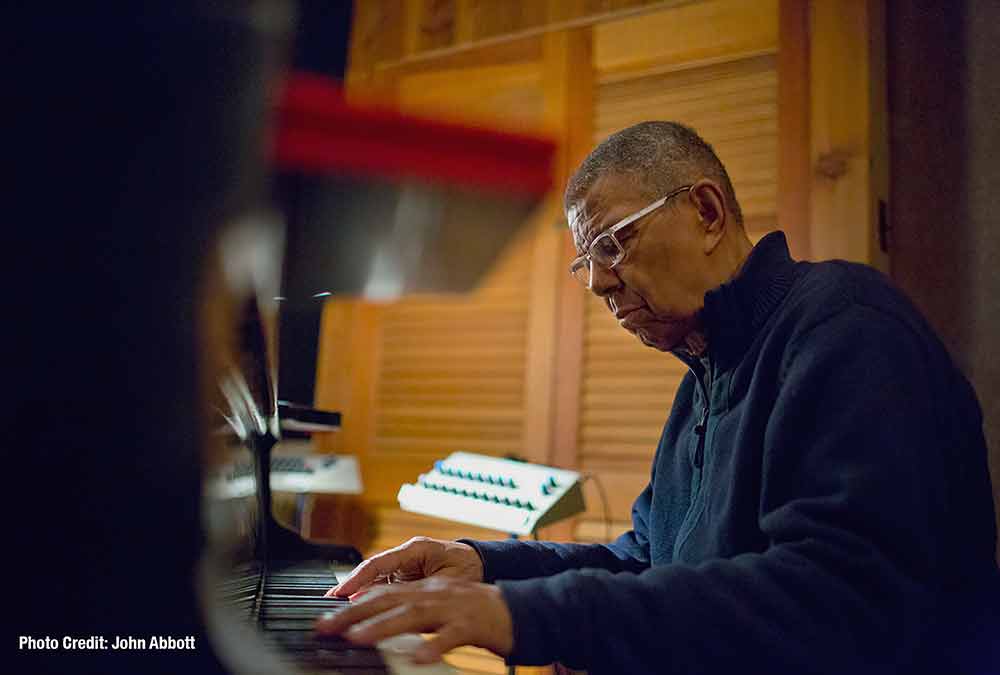
With the passing of Jack DeJohnette, one of the last great architects of modern jazz rhythm, the music loses not just a towering musician, but an entire worldview, an approach to sound, time, and communication that shaped generations of players and listeners alike.
For more than half a century, DeJohnette stood at the crossroads of nearly every major evolution in jazz. His death feels less like the closing of a career than the quiet dimming of a constellation whose light defined the art form’s contemporary history. Few musicians embodied the fluidity, openness, and courage that jazz demands as fully as he did.
A Name That Guaranteed Greatness
It’s hard to recall a time when Jack DeJohnette’s name wasn’t there, printed on the back of albums like an unspoken promise of excellence. From the late 1960s onward, his presence on a recording meant something would happen, something real, something alive. His sound could ignite a session or give it air to breathe. He was never ornamental. He was foundational.
For listeners of my generation, discovering DeJohnette often meant discovering the modern shape of jazz itself. My own encounter began through Miles Davis, those tumultuous, electric years between 1968 and 1971, when the drummer helped lead Davis into new territories that blurred the boundaries between jazz, rock, and something unnameable. On *Bitches Brew*, Live-Evil, and Miles Davis at Fillmore, DeJohnette’s playing was a revelation: liquid and mercurial, he transformed rhythm into atmosphere. He didn’t just keep time; he redesigned it.
The Complete Musician
To call DeJohnette a drummer has always felt insufficient. He was a complete musician, fluent in melody, harmony, and structure, capable of shaping music from behind the kit or from the piano bench. His early piano work, heard on albums like New Directions or Music for the Fifth World, showed an instinct for color and flow that paralleled his rhythmic imagination. He understood the architecture of a song from every angle.
He was also a composer of rare clarity, able to craft themes that sounded both inevitable and surprising. His writing balanced lyricism and abstraction, always leaving room for dialogue. Whether leading his own *Special Edition* groups or contributing to others’ visions, DeJohnette built frameworks that invited freedom rather than chaos.
The Alchemy of Collaboration
If DeJohnette had a secret, it was his ability to make every ensemble sound like its best self. His long collaboration with Keith Jarrett and Gary Peacock in the Standards Trio remains one of the most sustained acts of musical telepathy in jazz history. Over four decades, the trio turned familiar songs into laboratories of nuance, where silence mattered as much as swing. DeJohnette’s cymbals whispered and shimmered; his snare could speak in complete sentences. Even after hundreds of concerts, he never repeated himself.
But the list of his collaborations reads like a map of modern jazz: Charles Lloyd, Bill Evans, Freddie Hubbard, Sonny Rollins, Herbie Hancock, Dave Holland, Pat Metheny, John Scofield, the list goes on. Each partnership revealed another facet of his artistry. The early 1990s Parallel Realities project, uniting DeJohnette, Holland, Hancock, and Metheny, was emblematic of his approach: a dialogue among equals, fluid yet grounded, virtuosic yet deeply human.
The Pulse of a Generation
DeJohnette’s drumming bridged eras and aesthetics. He could summon the loose elasticity of Elvin Jones, the painterly textures of Paul Motian, and the crisp precision of Tony William,yet he sounded like no one but himself. His grooves breathed. His sense of time was elastic but never vague, abstract yet danceable. He could make chaos groove and order feel spontaneous.
That adaptability kept him vital across decades. When others aged into reverence, DeJohnette stayed curious, embracing new technologies, younger collaborators, and global sounds. His projects with artists like Ravi Coltrane and Matthew Garrison revealed a musician still searching, still expanding. Even in his seventies, he remained ahead of the beat.
The Spirit of Continuity
What set DeJohnette apart wasn’t only his technical mastery, it was his philosophy of music as a living conversation. He approached every performance as a moment of communion. In interviews, he often spoke of music as “healing energy,” a language that could connect souls beyond style or generation. That belief, perhaps more than his virtuosity, is what kept his playing so vividly alive.
Listening back today, we hear that spirit everywhere: in the thunderous momentum of Miles at Fillmore, in the crystalline poise of Jarrett’s *Tokyo ’96*, in the wide-open landscapes of In Movement. Each track carries a piece of his generosity, his humor, his fearlessness.
A Farewell in Time
Jack DeJohnette’s passing leaves a silence that jazz will not easily fill. Yet, like all true innovators, he left behind more than music—he left a way of being. His pulse lives in every drummer who dares to think melodically, in every pianist who listens like a drummer, in every bandleader who values conversation over display.
DeJohnette once said that his goal was to “make music that lifts people up, that brings light.” For over six decades, he did exactly that. And now, as we feel the absence of that light, we realize how deeply it illuminated the path for so many others.
The beat he set in motion continues. It’s in the records that shaped our ears, in the stages he graced, in the countless musicians he inspired. Jack DeJohnette didn’t just play the drums, he defined the rhythm of an age.