
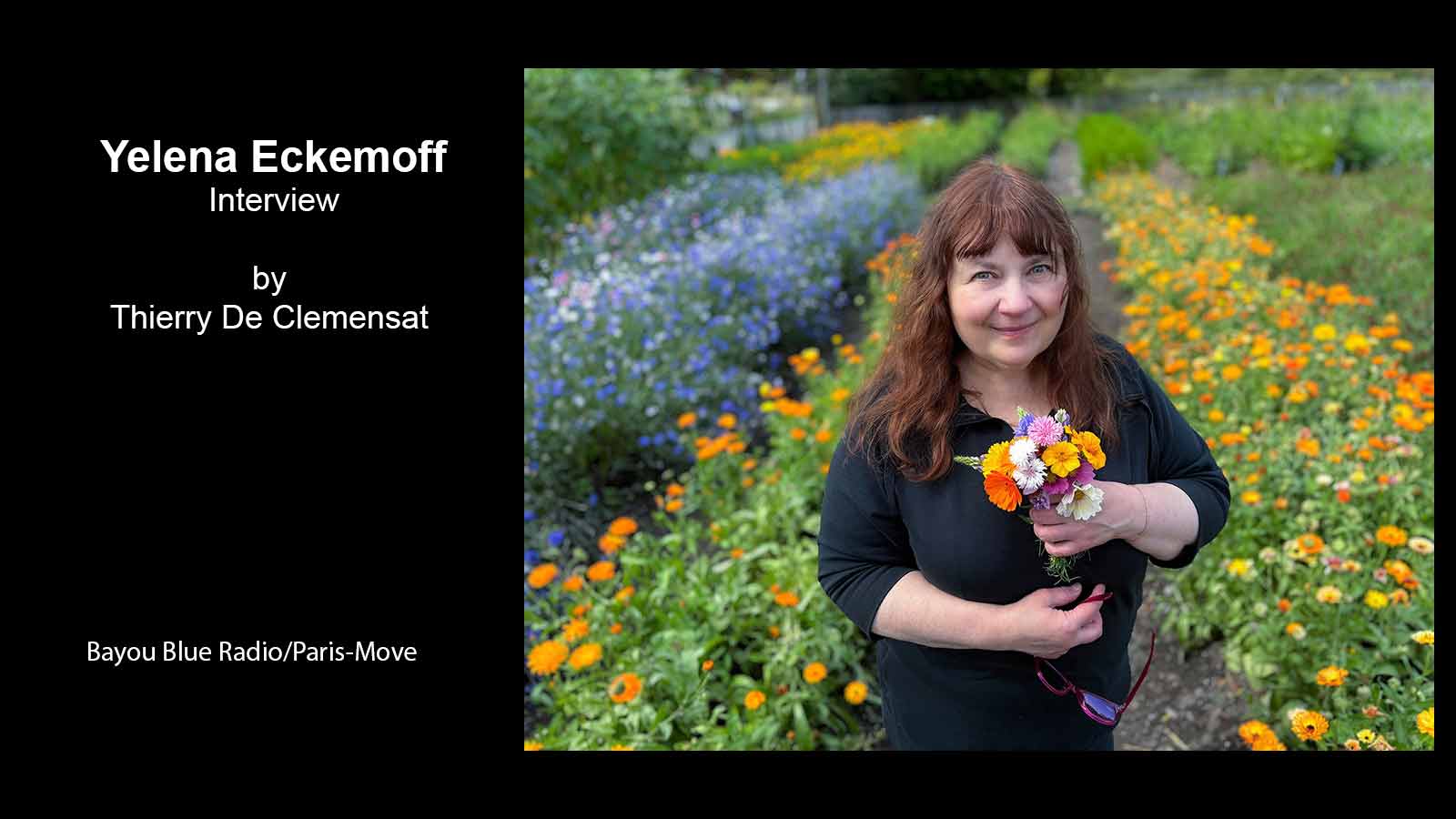
In the great American family of composers, a tradition shaped as much by migration as by melody, European émigrés have long played a defining role. The same holds true for journalists, scientists, architects. The United States has often functioned as both refuge and reinvention. Among those who crossed that ocean in the early 1990s was Yelena Eckemoff.
By then, her career in Moscow was already well established: professor of piano, composer, solo performer, and even participant in an experimental jazz-rock ensemble. And yet she left.
Thierry De Clemensat:
What was the motivation to leave Eastern Europe and come to the United States?
Was it artistic curiosity, political atmosphere, personal circumstances, or something less tangible?
Yelena Eckemoff: We had what I might describe as a call, a drive to leave Eastern Europe. We had this overpowering desire to emigrate, even though the task deemed to be nearly impossible at that time. It was very difficult and long process, but we made it – against all odds, and I remember how happy we were when we boarded an airplane that took off to New York.
Thierry De Clemensat:
Did leaving Moscow free you creatively, or did it create a rupture you first had to overcome?
Do you consider yourself today a Russian composer living in America, or an American composer shaped by Russia?
Yelena Eckemoff: I see my creativity as something that arises from within. My life experiences feed it like wood sticks feed the fire. This fire is always burning inside of me.
At that time, in Eastern Europe, music styles were much separated. I could be doing jazz there, or I could be doing classical music. In the United States I could experiment in combining both together.
I never thought of myself as composer of this or that nationality. I believe that music knows no geographical boundaries. But in purely technical sense, being citizen of the United States, I am an American composer.
Thierry De Clemensat:
Has your sense of “home” evolved over time, and does that evolution appear in your music?
Yelena Eckemoff: My sense of “home” is probably connected to nature. I think, we all came out of and connected to the nature even more than we might realize. There is only one thing that could pull me from my little home studio – it is to go for a walk or tend to my container garden. Also, when we were leaving for America, my father told me: “The home is where your family is.” Perhaps, I can add to this wise phrase: “The home is where my music is.”
The American years began not with major releases, but with adaptation: raising children, working quietly in a studio, experimenting with electronic techniques, searching for a new sonic vocabulary.
Thierry De Clemensat:
Was adapting to life in the United States difficult?
Yelena Eckemoff: We had to learn the language and adjust to different cultural norms. But we were young, everything is easier for young people.
And did the cultural shift influence your music?
I do not believe that cultural shift influenced my music that much, but rather listening to new music. To be fair, I had more opportunity to study new music in the US than back in Moscow, even though we had a lot of bootlegged music tapes there. But the biggest influence is my own life’s experiences and feeling, so perhaps I could say that the only one thing that truly influences my music is myself.
Thierry De Clemensat:
During that period, when public recognition was secondary, how did you measure artistic growth?
Yelena Eckemoff:
Before and now, public recognition is of low interest to me. I hope my music makes a positive difference in the lives of the people – the same way as somebody else’s good music I listen makes a world of difference for me. It is nice to have great reviews in premier press, but even if I had no recognition, I would still be doing exactly what I am doing now.
To many musicians and composers, recognition often comes too late. If you measure artistic growth by yardstick of recognition, you will always be playing and composing in prevailing musical style. Unfortunately, most of current players and composers do just that.
Even though I’ve been working for many years without public recognition as a composer, I had my share of recognition as a classical pianist. But it was never the prime goal for me to give solo recitals of classical music. I continued to compose and experiment with MIDI sequencing technology, which helped me to feel I am getting ahead in my work; then leading the local band was a very useful experience, so I’ve been moving forward with a good speed and getting primed for what started to happen for me after 2009.
Thierry De Clemensat:
When you compose today, who do you imagine listening?
Yelena Eckemoff:
This question prompts me to remember something from my past, when I had a perfect listener who always wanted to hear me play. It was my little son, who, one day stood very still next to my piano when I was composing. When I stopped, he asked me, “Will there be more music? I will stand here.” My recorder was running, and his words now start ‘Morning Hopes’ – first track of my early album called “Kaleidoscope of Life” (2002).
I imagine a perfect listener, who plays my music either during driving, or studying, or working, or resting, for family dinner, for breakfast, etc. – preferably on the audiophile equipment or at least through some descent speakers. I surely hope that this listener would want to have repetitive listens to be able to hear all the intricate details and the variety of textures in my music.
Thierry De Clemensat:
Is composition for you discipline, necessity, or something closer to survival?
Yelena Eckemoff:
I don’t have to discipline myself to compose on the regular basis, because my head is always filled with tunes, ideas, grooves, and as soon as I have a moment, I’d write them down. (Quite opposite – I try not abstain from composing too much these days, because the stack of new unused tunes has been growing and I am afraid I won’t be able to see all these tunes and compositions recorded or arranged in my lifetime.)
I’ve always been composing to make sense of this world; it is how I find harmony with what’s around me. This makes my composing a necessity for my wellbeing, almost as important as breathing.
Gradually, you assembled a group of local musicians and began releasing albums across genres, classical, vocal, folk, sacred. The jazz breakthrough came in 2009 with Cold Sun, recorded with Peter Erskine and Danish bassist Mads Vinding.
From that moment, your American career accelerated.
Thierry De Clemensat:
Looking back at that first jazz album in 2009, how do you view your trajectory and evolution?
Has your development felt deliberate, or organic?
Yelena Eckemoff:
I studied jazz as teenager in a jazz music studio, alongside my classical studies. Since that time my music always had elements of jazz. One of my very early solo albums “Kaleidoscope of Life” (2002) was improvised on MIDI sequencer. “The Call” (2006) was recorded with local NC musicians in chamber jazz format.
My local musicians had their daytime jobs, and we rehearsed and performed in the evenings and weekends. It was all secondary work for them. It was not enough for me to get together occasionally and to rehearse. By 2009 I decided to give up idea of local band and to work with professional jazz musicians. First one who I found via My Space was Mads Vinding. He lives in Denmark. Second one was Peter Erskine. He lives in LA. Naturally, “Cold Sun” (2009) was recorded remotely. I was crying from happiness as I was listening to first mixes.
Working remotely with the great jazz bassist Vinding was the most valuable ‘school’ for me that prepared me for the future live recordings. From that point on I felt like I had a jolly ride on a speed train that stops ones or twice a year at the recording studios and continues to zoom forward. I could never imagine how far it would take me!
Thierry De Clemensat:
What did success mean to you then, and what does it mean now?
Yelena Eckemoff:
Success to me has always meant, it means now and will always mean – when people enjoy listening to my music. I was told many times by my fans that my music improved quality of their lives.
Thierry De Clemensat:
If you had to choose one album that defines your artistic identity, which would it be, and why?
Do you feel you are still evolving stylistically, or refining something you have already found?
Yelena Eckemoff:
I’ve been evolving ever since I started to compose around 4 years of age, and with each new project I’ve been seeking to find new ways to express myself and my ideas. So, each new album is the latest proof of how I’ve changed. As far as the album that defines my artistic identity, I think that any of them can be named as such, but I usually feel the closest to my latest work.
Your output since then has been remarkably prolific, sometimes drawing comparisons to Satoko Fujii.
Thierry De Clemensat:
How do you sustain originality at such a pace?
Yelena Eckemoff:
I believe that originality has no faster or slower pace. I think, you are either original or you are not. I hope that my originality is not diluted with each new project, but on the contrary – gains more strength as my skills get more mature and refined.
Thierry De Clemensat:
Do you ever fear repetition, or do you see recurrence as thematic continuity?
Yelena Eckemoff:
I never repeat a project, no matter how successful it was. Even if I invite some musicians to work with me again, I change both the band and the concept of the project, and I look for new angles execute it. For example, I had Arild Andersen on six of my projects (the sixth one has not been released yet). And each time it was a different band. So, if you compare “Glass Song” (with Peter Erskine) and “Lions” (with Billy Hart), you can hear that these were very different sounded trios, and not only because of a different drummer, but because of the music itself.
Thierry De Clemensat:
How do you know when a piece is finished?
Yelena Eckemoff:
When I compose, a piece is finished when I draw the final bar line. After that, I may edit the score, yet the final touch the piece gets after it is recorded. During the rough mixing, I have to tell myself that I need to stop at some point, otherwise I will be improving it for the next month.
Thierry De Clemensat:
Have you ever abandoned an entire project, and for what reason?
Yelena Eckemoff:
I do not abandon projects, I just may put them on backburner. I consider the work of my life is setting Biblical Psalms to music. All the Psalms that I compose have vocal lines. I was able to record many instrumental Psalms, but made only one record of vocal Psalms so far. I tried hard to find more singers who could do justice to my Psalms – the way I see it. But my search has not yielded any satisfactory results yet. I haven’t given up the hope to find the right ones, even though I stopped looking for now.
Thierry De Clemensat:
Are you moving toward larger forms, orchestral works, opera, or toward increasingly intimate statements?
Yelena Eckemoff:
If I were commissioned to write a symphony, or opera, or ballet, or big band arrangement, I would get interested. Otherwise, these larger forms don’t make sense to me. In any case, even if I had a choice, I’d prefer the intimacy and transparency of a small group over big band or orchestra. So far, none of my pieces needed to be done in larger forms, even though re-arranging is always a possibility.
—————————–
Thierry De Clemensat:
Nearly every European musician begins with classical training, and its influence remains audible in your harmonic structures.
Yelena Eckemoff:
“We all came out of Gogol’s ‘Overcoat,” the most famous saying of Russian literature goes. In the same way, I believe that in the modern music all composers worth of their salt come from Bach, Beethoven, Mozart, Schubert, Chopin, Rachmaninoff and other giants of classical music.
Thierry De Clemensat:
Is classical form the only viable framework for expressing deep emotions, landscapes, or the divine?
Yelena Eckemoff:
I don’t think about the forms when I compose. It’s like the music shapes itself up to a certain form depending on the initial tune and my inspiration while I’m composing or improvising. Not breaking things down to different forms, I feel free to benefit from all of the musical forms known to me and combine their elements together in whatever way I like. Some of my compositions have very elaborate structures, but I also have some very simple pieces, and I never know which one it’s going to be until I’m finished with it.
Does jazz offer a different kind of freedom, or simply a different structure?
Jazz gives my bandmates an opportunity to join in with my music without forsaking their own identities. It is like a conversation between us. As composer and pianist, I ‘talk’ to them through melodic, harmonic, and structural development, and through my piano playing, and they ‘talk’ back to me to and to each other with their interpretation of my tunes and their improvisations.
Is improvisation, for you, a spiritual act?
Yelena Eckemoff:
Not only improvisation; but, in my view, the entire process of creation of a musical piece when the whole band plays it either in studio or on the stage – is a spiritual act.
In practical terms, I consider my own improvisations as integral parts of melodic development of my music structures.
Thierry De Clemensat:
In your harmonic language, do you consciously bridge Russian romanticism with American jazz modernism?
Yelena Eckemoff:
Even though I never concerned myself with this question, some music critics see me as the next link in the chain of major and minor Russian composers. However, since I equally studied all Western composers, I was as much influenced with them as with Russian composers, perhaps even more.
Collaboration has been central to your projects.
Thierry De Clemensat:
When you work with musicians of the stature of Peter Erskine, how much interpretive space do you allow?
Yelena Eckemoff:
Talking about drummers, I should say, I give them 99 percent of freedom of interpretation, since I don’t write any percussion parts. One percent goes to things like whether to play sticks or brushes and whether I may want some additional percussions like shaker or anything else.
But some drummers want to know what exactly I ‘d like to express in the music. For example, when we recorded track ‘Waves and Shells’ from “Everblue” with Jon Christensen, I asked him to play the sound of sea shells on the beach, which he did wonderfully. And Billy Hart was playing how the coals crackle in the fireplace, while it’s snowing outside, in track ‘Imagination’ from “A Touch of Radiance.” Or he played the sound of flying birds’ wings in track ‘Migrating Birds’ from “Lions.” And there are many more examples like that.
Speaking about the pitch instruments musicians, I give them their parts from my scores containing tunes and lines that are written out, and the spaces for improvisations. I usually don’t tell musicians how they should interpret my music, trusting their intuition and the chemistry between band members at the time of the recording.
Thierry De Clemensat:
Do you compose with specific performers in mind?
Yelena Eckemoff:
When I conceive a new project, I try to assemble the band as soon as possible, because I like to know how musicians might sound and what each of them could bring into the fold, which gives me an opportunity to write better scores for the project.
But of course, there are many occasions when I compose without any particular project in mind. Even though, it happens that I might start hearing in my head that a particular musician performs certain tine. Then I mark that musician’s name on the music score – just in case.
Thierry De Clemensat:
Has an improviser ever taken your composition somewhere unexpected, and changed your own perception of it?
Yelena Eckemoff:
Absolutely. There are quite a few pieces which were recorded not in the way I thought they should have sounded. For example, when we recorded track ‘Sands’ for “Desert,” it came out not as energetic as I heard it in my mind. Then I asked my band to record it again with more gusto. But when I heard both takes in my ProTools while doing the rough mix, I realized that the initial (ethereal) variant was hands down the best one. Another very recent example – the track ‘ABBA Museum’ from my new album “Rosendals Garden.” Svante interpreted the main tune with more liberty in phrasing, while I heard it rhythmically strict when I wrote it, and at first, I was not sure if I liked it. But after a while I was very happy with Svante’s approach. To me, this is the best part of making music together, when the bandmates take my compositions somewhere unexpected.
Thierry De Clemensat:
Alongside music, painting occupies an important place in your creative life; many of your album
How does painting interact with composition?
Yelena Eckemoff:
I stared to draw since very young age, same age I started to play the piano. It is hard to imagine now, but I distinctly recall that my parents had a discussion, what specialized school I am to go to: to piano school or to drawing school. It is possible, in alterative Universe there is another Yelena who is well-known professional artist, with frequent exhibitions, who also plays piano and casually composes music.
Since I became a professional musician rather than professional painter, painting is the secondary way for me to express myself, supplementing what I express through sound.
By the way, my great-grandfather was a professional painter who studied with Isaak Levitan. When I tried oil painting in my early 20th, I knew that oils were in my blood, and I felt some kind of genetic memory.
My great grandfather had a very hard life. Most of his pictures were destroyed during WW2. I already composed and recorded a very special project (with Arild Andersen, Billy Hart and Paolo Fresu) as a tribute to his life. This project entitled “Forgotten Artist” and is coming out in 2028.
Thierry De Clemensat:
When you paint, are you thinking musically?
Yelena Eckemoff:
I paint the illustrations to my music and my conceptual ideas this music expresses. Naturally, there is a tight connection between the music and the paintings
Thierry De Clemensat:
Have you ever composed directly from one of your canvases?
Yelena Eckemoff:
Normally, it’s the other way around: I would paint from my musical pieces.
That being said, I also paint pictures that have nothing to do with my music or story behind my musical projects. Some of these paintings later might connect in my mind to this or that incoming project. In that sense, it is possible that as while these paintings on my walls, they influence forming some of my musical ideas. For example, I used my older landscape paintings for the cover art of “Leaving Everything Behind” (2016), “Better Than Gold and Silver” (2018), “In the Shadow of a Cloud” (2017) and “Colors” (2019).
Thierry De Clemensat:
Do colors correspond to tonalities in your imagination?
Yelena Eckemoff:
Actually, I do see the notes of the scale in colors. For example, F is red, B is green, G is navy blue, A is pale blue, E is brown, etc. However, this is not related to the choices I make when I write in a certain tonality.
During periods of intense writing, where does painting fit into the creative cycle?
Yelena Eckemoff:
Painting usually comes after music and story – if I have a story. For example, I’ve just finished a big story for the project I recorded last September (for the next year’s release) and now I am painting two illustrations and a cover art.
It often seems that each album carries a narrative dimension, almost as if each were a novella without words.
Thierry De Clemensat:
How do these stories emerge?
Yelena Eckemoff:
Soon after I started to play by ear at age 4, I began composing little pieces about fish, birds, animals, etc. My mother Olga who was a professional pianist, wrote them down in a music notebook which I still have. Ever since, I was a composer of programmatic music. Seeing on-stage Tchaikovsky’s ballet “Sleeping Beauty” at sever years of age, which was the biggest theatrical impression of my life, majorly contributed to my desire to express things in music. Idea of a subject or a story comes to my mind, then I find the sounds to fit it in.
Thierry De Clemensat:
Is the writing process long and gradual, or born from sudden clarity?
Yelena Eckemoff:
Ideas come fast; putting words down is a slower process. Words for me are not as natural way of expressing myself as the music is. That being said, I was told that I have my own distinctive style, of matter-of-fact fairytale nature. Maybe, it is because fairytales were my favorite books that fed my imagination as I was growing up.
Thierry De Clemensat:
Is solitude essential to that process?
Yelena Eckemoff:
Very essential. I prefer complete solitude when I am immersed in writing.
Your recent project, Rosendal’s Garden, appears in some ways to echo the spirit of your 2009 beginnings.
Thierry De Clemensat:
Is this connection intentional? Or does it signal an evolution toward compositions that lean more deeply into jazz language?
Yelena Eckemoff:
I guess, the right tool is for the right job. Perhaps, all my trios have something in common, but I think it is mostly because my piano has to come more upfront in the thinner instrumentation, while in the settings with a reed/wind instrument or guitar/vibes the piano is overshadowed and music loses a bit of ‘Yelena’s personal spirit.’ I am not sure if the jazz language has gained deeper meaning for me, because I believe it has always been my desire to infuse my records with as much jazz as my music can absorb. But it also depends on the band members. I think, my New York bands have always sounded somewhat jazzier (at least in American sense of jazz) than my European bands.
Thierry De Clemensat:
When an artist circles back to earlier aesthetics, is it return, or refinement?
Yelena Eckemoff:
If one progresses, it is refinement, I’d like to think that I am progressing. I also believe that musically “Rosendals Garden” is in many ways very different from my earlier trios. One of the differences is that it is very heavy on the free group improvisations, while in my early trios there were primarily just structured improvisations. Even though, as you said, there are similarities in the aesthetics.
Finally:
Thierry De Clemensat:
What would you like younger composers, particularly women, or immigrants navigating artistic careers, to understand from your journey?
Yelena Eckemoff:
If only possible, stay away from record labels. They will have ideas about what and how you should play, sound, and compose. It’s better to be a seed, find good patch of soil, and grow. If your growth is organic, it is always unique. You could end up as tall poplar or short field flower, it still will be you. People need tall trees for shade, but people also love flowers. But don’t fall for a help of AI in creating music. Short cuts are short lived.
If you are a creative musician, do not plan to make living from your art. It would be fine if you’re lucky to earn enough. But nowadays it is getting harder and harder. Remember that even many musical giants of the past made living by directing choirs, playing in churches and working in restaurants. Think of your art as something you might leave for posterity rather than trying to please everybody in order to be approved and gain recognition. Trust your guts more than opinion of the others. And most importantly, work hard and never give up!
Thierry De Clemensat:
What questions are you asking yourself now that you were not asking fifteen years ago?
Yelena Eckemoff:
How to break through to people in the age of information overload, while the people’s attention span is getting shorter and shorter?
Thierry De Clemensat:
And what remains musically unexplored for you?
Yelena Eckemoff:
Everything that I have not tried yet!!!