
photography copyright:Thierry De Clemensat
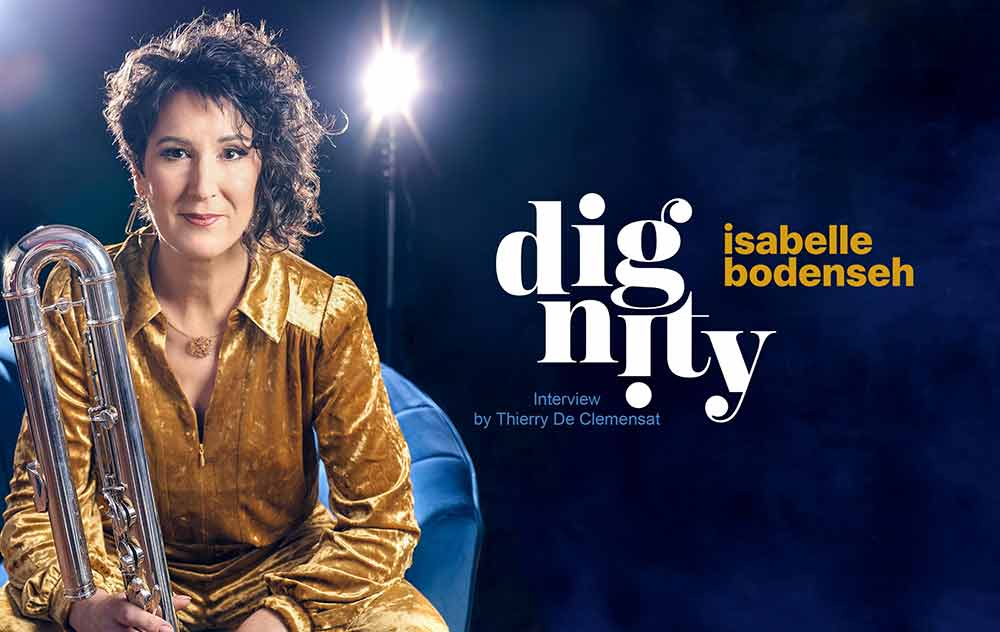
Isabelle Bodenseh’s latest album, Dignity, does not assert itself through demonstrations of virtuosity or spectacular effects. Instead, it unfolds with restraint and patience, inviting the listener to slow down and listen attentively. From the very first bars, the deep, enveloping voice of the bass flute settles in, warm, introspective, almost carnal, guiding the music toward a territory where jazz converses with the classical tradition and certain forms of folk sensibility. Here, silence is not emptiness but a structuring element; breath and resonance matter as much as melody.
More than a simple musical object, Dignity is a profoundly human project. Inspired by the lived experience of Isabelle Bodenseh’s daughter Juliette, who lives with a severe disability, the album transforms the intimate into the universal. Vulnerability is never perceived as weakness, but as strength; difference becomes a source of connection rather than distance. Each piece unfolds like a chapter, forming a suite that evokes resilience, tenderness, and hope, an artistic gesture rooted as much in ethics as in aesthetics.
It is from this space, at the crossroads of personal history, artistic rigor, and open exploration, that Isabelle Bodenseh speaks.
1. Thierry de Clemensat
Hi Isabelle, and thank you for agreeing to this interview. I’d like to begin with your bicultural background. Coming from both German and French cultures, has this dual heritage influenced the way you compose? And if so, how does each culture feed into your creative process?
ISABELLE BODENSEH:
It’s a great pleasure for me to do this interview with you, and a wonderful opportunity.
I’m very happy to respond to your questions, which I find truly interesting.
My Franco-German background obviously shaped me very early on, but I never experienced it as a division. I’ve always felt whole, and even today I’m very happy to be able to bring these different influences together within myself.
Looking back, I sense that certain aspects may come more from the German side, which I tend to associate with classical music: a sense of depth, of structure, and a certain rigor in approaching music.
On the French side, I feel more lightness, improvisation, a taste for sonic colors, a form of sensuality and openness, a direct connection to emotion. This probably also comes from French chansons, which I’ve always loved, as well as from Impressionist music and painting.
Ultimately, all of this now blends very freely with the experiences I’ve had in many countries. I don’t think in terms of borders or styles anymore; I simply let circulate whatever touches and inspires me in the present moment.
2. Thierry de Clemensat
In your biography, you mention discovering the flute at the age of three during a concert. What drew you, so early on, to the transverse flute in particular?
ISABELLE BODENSEH:
I started very early, at the age of three, with the recorder.
Then, around the age of six, I discovered the transverse flute at a concert, and that moment was decisive for me. It wasn’t a reasoned decision, but rather an obviousness, a deep fascination with this silvery instrument, light, almost smiling.
What immediately touched me was the breath, the fact that the sound emerges directly from the body, without passing through a complex mechanism. From the very beginning, the transverse flute appeared to me as a very human instrument, almost like an extension of the voice.
This direct connection between the inside and the outside deeply marked me as a child. I’ve always felt that this instrument did me good, and that’s also why I’ve remained faithful to it to this day.
3. Thierry de Clemensat
You describe yourself as a “musician of the world,” a notion that can follow many paths, notably those of classical music and jazz. How did your transition toward jazz and improvised music take place?
ISABELLE BODENSEH:
My musical path did indeed begin in a very classical way, with solid training and clearly defined structures. That was important and deeply formative.
At the same time, my father played a lot with me and encouraged me very early on to play by ear and to improvise. That left an essential mark.
I first studied orchestral music, but quite quickly I felt something was missing. Improvisation had already opened up a space where I enjoyed taking responsibility, making choices in the moment, and living with the uncertainty of ad hoc composition. That uncertainty was never an obstacle for me, on the contrary, it was always a source of inspiration and movement.
Jazz therefore didn’t arrive as a rupture, but as a natural extension of my musical language. Improvisation became, very early on, even during my studies, my true elixir of life.
It was almost inevitable that I would continue my path in Los Angeles with James Newton, and then spend an entire year in Havana, Cuba, thanks to a DAAD scholarship. That period allowed me to immerse myself deeply in Afro-Cuban musical culture.
My goal has always been to acquire such musical mastery that I could make music anywhere in the world, regardless of context, style, or the people I’m playing with.
Later, I passed on these experiences for many years at the University of Music and Performing Arts in Frankfurt am Main, teaching improvisation and accompanying projects related to Latin American and Cuban music.
(Jazz and improvisation are extraordinary means of expression for me. They are my inner language. In this music, I can express without words everything I’ve lived through: my studies abroad, my encounters, but also my personal path as a mother and the very profound experience of accompanying and raising a severely disabled child. Improvisation allows me to transform all of this into music, in a living, free, and deeply human way.)
4. Thierry de Clemensat
More broadly, do you see your work as belonging to a specifically European approach to jazz, or do such labels feel limiting to you as an artist?
ISABELLE BODENSEH:
I understand the idea of a European identity in jazz, but for me these are above all categories seen from the outside.
Of course, I grew up and was trained in Europe, and that inevitably shaped my musical language.
At the same time, I experience music as something deeply personal and fundamentally without borders. That’s precisely why I went to study in Los Angeles and in Cuba. I needed to broaden my horizon, to encounter other musical cultures and other ways of thinking and feeling music.
Ultimately, what matters to me is not whether a music is European, American, or South American. What matters is that it is honest, that it arises from an inner necessity, and that it says something about the human experience.
5. Thierry de Clemensat
On your album Dignity, you chose to foreground the bass flute, an instrument still uncommon in this type of ensemble. It brings a very singular color to the whole. How do you perceive its role in this musical context?
ISABELLE BODENSEH:
The bass flute is central to Dignity. Its deep, warm sound brings a strong sense of grounding and calm to the music. It forces me to slow down, to breathe more consciously, to listen more attentively, and to articulate more precisely. For an album that speaks about dignity and vulnerability, it was the ideal instrument for me.
It carries the music without ever imposing itself in the foreground and opens a space for very deep emotions. Playing the bass flute has an almost therapeutic effect on me, because its vibrations have something very balancing about them.
I feel that I can express myself directly from my deepest heart through its sound.
At first, however, it wasn’t easy to integrate the bass flute into the group’s sound, because its frequencies can easily blend into the overall texture. We therefore worked very carefully on the arrangements in order to bring out its qualities fully.
6. Thierry de Clemensat
Your music often leaves a great deal of space for breath, resonance, and silence. What importance do silence and restraint hold in your musical language?
ISABELLE BODENSEH:
Over the years, silence has become an active and essential element of music for me.
With time and experience, I felt the need to slow down, to leave more space for breath, resonance, and listening. There are phases in a musician’s life where virtuosity, density, and performance take center stage. But with inner maturation and questions of values, restraint and silence have become indispensable to me. They create a space to breathe, listen, feel, and let the music unfold differently. I am convinced that music doesn’t need to be loud or dense to be intense. Often, depth arises precisely from what one chooses not to play.
This approach is also deeply connected to my personal life and to my daughter Juliette. She is severely disabled and cannot speak, walk, or control her movements. Silence is therefore an integral part of our daily life. With her, I’ve learned that reduction can be incredibly rich. We’ve developed a very simple, almost minimal form of communication. She evaluates things on a scale from one to nine, from very good to very bad. This simplicity allows for astonishing clarity and has deeply marked me.
Time also plays an essential role. When I care for her with calm, presence, and patience, life becomes more peaceful and harmonious. This experience has influenced my way of making music. Silence, slowness, and attentiveness have become central values in my musical language. In a way, the bass flute is also a response to Juliette. Its deep, warm timbre forces me to slow down, to breathe consciously, and to remain fully present, even when the world around me becomes chaotic.
7. Thierry de Clemensat
This naturally brings us to the art of composition. Creation cannot be decreed; it is born of visceral necessity. In your case, it seems clear that you seek to tell stories, with the flute alternately serving as setting or main character. How do you approach this narrative dimension when you write?
ISABELLE BODENSEH:
The need to tell stories through music has grown a great deal for me in recent years.
When the idea of Dignity was born, the idea of composing around human dignity, I had absolutely no idea what the music would sound like.
One day, I sat down at the piano with a very clear intention: to set no limits for myself. No constraints, no preconceived ideas, not even about instrumentation. I wanted to make space, very radically, for what came from within. To listen to what my inner self had to say.
I began writing the first piece, and very quickly I felt that this theme was too vast to fit into a single piece. That’s when I understood that I truly wanted to tell something, not a linear story, but a journey, with several chapters. That’s how the Suite was born.
The different atmospheres, emotional states, and musical situations developed very naturally. I didn’t need to force them. My work mainly consisted in finding the right order among the different parts, an order that, in hindsight, revealed itself to be surprisingly logical and coherent.
For me, the flute is a non-verbal language. When I compose, I think a lot in terms of inner images and emotional states. But I don’t tell stories in the classical sense. Rather, I open spaces.
The flute can be alternately an observer, a narrator, or fully involved in what is happening. What matters to me is that the music explains nothing, it invites. Each listener should be able to find their own experience, their own reading.
It’s a very personal story that I’m telling, but it remains deliberately open. The music becomes a space of resonance, where everyone can recognize themselves, reflect, and feel. And that is precisely what is essential to me.
8. Thierry de Clemensat
When you compose, how do you find the balance between structured writing and spaces left for improvisation? Is this balance defined in advance, or does it evolve organically with the musicians?
ISABELLE BODENSEH:
This balance is not born at a desk, but in collective playing.
Of course, I provide structures, atmospheres, sometimes clear themes or a few chords. But the essential things happen in the moment.
With my group, this developed very organically. We really listen to each other; we trust one another. The music is allowed to change, even from one concert to the next.
This is especially true for Juliette, Epilogue. With this piece, we rediscovered our way of playing together. The musicians don’t have a traditional score on their stands, but rather a kind of musical staging, with a few key points where a change must occur. Everything else is fairly free improvisation.
The whole group was deeply touched by this process, because everyone felt they could engage with the music as a human being. Together, we make the themes related to human dignity audible and perceptible, each in their own way.
9. Thierry de Clemensat
Collaboration clearly seems essential in your work. What do you primarily look for in the musicians around you: technical mastery, shared values, or something more difficult to define?
ISABELLE BODENSEH:
For me, technical quality goes without saying.
It’s an indispensable foundation, because only then can musicians truly unfold their freedom. But it’s not the essential thing.
What I look for above all are musicians who can listen, take responsibility, and want to fully commit themselves. Shared values, respect, and openness are fundamental to me.
I’m deeply grateful to play with this group. It’s not obvious to find musicians willing to immerse themselves so deeply in a very personal subject that doesn’t necessarily concern them directly. But we’ve been playing together for ten years, and the trust built over time has become a central element of our music.
After many concerts, hotel nights, and long hours in the car, we’ve talked a lot—also on a personal level. The fact that they are all fathers also creates a form of shared understanding.
I can truly say today: this group makes music together, in the deepest sense of the term.
10. Thierry de Clemensat
Dignity is a profoundly humanistic and emotionally charged project that touches you very closely. How does one infuse so much life and hope into a work of this nature? Your personal experiences clearly shape a worldview that may differ from that of the majority—how does this perspective nourish your music?
ISABELLE BODENSEH:
Dignity was born directly from my life.
The twenty-three years spent with my daughter Juliette, who is severely disabled, with my son Jean-Luc and my husband, have profoundly transformed my view of the world. I learned that vulnerability is not a weakness, but an immense strength.
I’ve always sought intensity in music. Communication on stage, the bond between musicians, the energy shared with the audience have always been essential to me. Music has always been linked, in my eyes, to life and hope. I’ve always wanted to offer music that is true, alive, full of momentum and joy.
Juliette’s birth marked a deep rupture, a new way of measuring time. She arrived with severe disabilities, and very quickly we had to adapt to a demanding reality. The difficulties linked to inclusion, institutions, society, schools, or the healthcare system hit us head-on.
But at the same time, there was Juliette, an incredible personality. A fighter. Curious, generous, adventurous. Very quickly, we understood that the values she embodied, meeting others on a human level, tolerance, respect for each person’s rhythm, the courage to remain open to the world, were infinitely stronger than all the obstacles we faced.
This perspective doesn’t translate into my music in a narrative or illustrative way. It unfolds in a broader, more universal manner. Dignity is a suite that traverses different emotional states and phases of life that everyone can recognize: loss, illness, disappointment, moments of doubt, then getting back up, fighting, learning again, rediscovering love, energy, and vital momentum.
The music follows these inner movements. It passes through fragile, suspended zones, then regains strength, pulse, and collective breath. It’s not a closed story, but an open emotional arc, into which each listener can project their own experience.
Our family has become a small but very dense and vibrant universe, in which I’ve learned what humanity and dignity truly mean. Living with Juliette is an honor. She has shown us what truly matters. When a child comes into the world with so many challenges, a good day is simply a day when you’ve lived together, eaten, drunk, slept. Everything else is, as I often say, a bonus in life.
This experience has deeply nourished my music. It isn’t sad. It’s alive, full of presence, hope, and dignity. It has also taught me another way of communicating, with someone who doesn’t speak, but understands everything.
I am deeply grateful to jazz and improvisation. They taught me discipline, flexibility, endurance, and the ability to remain open to the moment. All of this naturally finds its way into Dignity.
11. Thierry de Clemensat
What kind of emotional or intellectual resonance do you hope to awaken in listeners of Dignity?
ISABELLE BODENSEH:
I don’t expect a specific or programmed reaction.
Above all, I hope that listeners take the time to truly listen. That they allow themselves to be touched, without any obligation to immediately understand or analyze.
On an emotional level, I’d like Dignity to open an intimate space of resonance, where everyone can recognize something of their own life path: moments of fragility, loss, doubt, but also of strength, movement, and renewed confidence.
On a more intellectual level, of course, I also hope the music can raise awareness, of themes such as the inclusion of people with disabilities, tolerance, equal rights, respect for human rights, and the dignity of every human being.
In an interview like this one, where the questions are posed with such depth, which is quite rare, and for which I sincerely thank you, I can go much further in explaining what this project means to me.
Originally, I had imagined Dignity, in its outward presentation, as a more abstract, almost intellectual project. I even thought about keeping Juliette’s story more in the background. But things took a different direction.
Very spontaneously, almost unexpectedly, the composition Juliette was born. From that moment on, it became obvious that I could no longer separate the music from this lived reality. Everything changed: the way the project was presented, the relationship to authenticity and openness.
The fact that photos of my family appear in the artwork, that fragments of voices from my husband and my son Jean-Luc, and even Juliette’s laughter, are part of the album, none of this was planned at all.
This honesty undoubtedly makes the project more vulnerable, more exposed. But very sincerely, today I am deeply happy to have found a meeting point between my life as a professional musician and my life as a mother.
For the first time, I feel I can be fully honest. And if this music can touch people, open them up, raise awareness, and perhaps give them a little more presence, respect, and courage, then it has found its meaning.
12. Thierry de Clemensat
Jazz today unfolds in many directions, which I see as a very positive sign of its vitality. In this constantly evolving landscape, how would you define your own artistic project?
ISABELLE BODENSEH:
I also experience today’s jazz as extremely alive and diverse, and I find that very stimulating.
I situate my project within an open jazz that embraces movement, dialogue, and constant transformation. I don’t try to follow trends, but rather to listen to my inner voice. What matters most to me are expression, depth, and sincerity.
With Dignity, I feel I’ve opened a new door, for myself and for the group. It’s a project that can clearly evolve, transform, and also dialogue with other artistic forms beyond the strict framework of jazz. For a long time now, my compositions have lived in different contexts, with other ensembles, sometimes larger ones, and I love the fact that they take on a new life through other musicians, for example with Sisters in Jazz International or the La Serena ensemble.
It was only in 2016, after more than 1,400 concerts and many productions, that I founded my own group. Since then, I’ve recorded five albums with increasing amounts of original music. Today, I have a very clear sense of being at a particularly interesting starting point, where everything I’ve learned so far can finally come together and open toward the future.
13. Thierry de Clemensat
Finally, I’d like to hear your thoughts on another significant phenomenon: the growing presence of women composers in jazz. We can cite, among others, Ingrid Laubrock, Renee Rosnes, or Kandace Springs, each working in very different worlds, yet all showing great originality and artistic rigor, widely praised by jazz journalists. Do you think women bring a particular way of approaching creation? And in your view, how are they contributing today to redefining contemporary jazz?
ISABELLE BODENSEH:
I find the growing presence of women composers in jazz very encouraging and long overdue. Jazz can consider itself fortunate to bring together under one roof such diverse artistic writings, aesthetic worlds, and ways of working.
I don’t believe that women compose in a fundamentally different way, nor that they inherently have a unique approach to the creative process.
However, it must be said very clearly that everyday life as a mother leaves deep traces, especially when spaces of freedom can no longer be taken for granted. As a mother, I simply cannot afford to devote myself for years to extended compositional processes when, in parallel, there are school meetings, medical appointments, or helping children with homework.
Our way of working is therefore often very focused and condensed: we work in shorter time spans, with great intensity and heightened inner presence.
Many women bring experiences, perspectives, and sensitivities that were long absent from the dominant jazz discourse: work nourished by biographical depth, particular attention to relationships, listening, vulnerability, but also inner strength. This diversity is a great richness for jazz. It can, though it’s not a rule, influence the way music comes into being. Fixed images of the “typical woman” or the “typical man” seem completely outdated to me today. What I’m describing here is more a tendency, an evolution, dependent on many factors.
For me, the essential contribution of women composers today is not that they seek to redefine jazz, but to expand it. It’s less about gender than about authenticity, coherence, and the freedom to follow one’s own path. They open spaces where complexity, contradictions, intimacy, and societal questions can naturally be part of the music. Contemporary jazz becomes richer, more diverse, and more human as a result. And that is precisely where I see a form of dignity: the possibility for many voices to coexist, without having to justify themselves.
A good example is my concert tours with Sisters in Jazz International. It’s an extreme case, since only women play together. You can clearly feel that backstage and during travel, the exchanges are different from those in mixed groups. Discussions are often more open and honest; we advise each other on musical paths as well as on life realities such as motherhood. No one is afraid of devaluing herself by showing her true face. It’s less about power than about sharing.
This naturally has an impact on communication on stage. The musical dialogue often becomes deeper and more direct. Of course, this can work just as well in mixed groups, and it’s not always the case. But I feel that in this context, the probability of an exchange that is both empathetic and of very high artistic quality is particularly high.
14. Thierry de Clemensat
To conclude, has Dignity opened up new artistic perspectives for you, conceptually, instrumentally, or in how you envision your future projects?
ISABELLE BODENSEH:
Yes, Dignity has opened new perspectives for me on several levels. Conceptually, it allowed me to think of music more as an open narrative space, where life experiences, emotions, and human questions can coexist without needing to be explained or justified.
Instrumentally, I’ve refined my relationship to sound, breath, and time, deliberately leaving more space for breathing, fragility, and silence. And in how I conceive future projects, Dignity has given me the courage to follow even more resolutely an artistic direction that feels right and authentic to me.
I’m also keen not to set overly narrow limits on the people I play with, or the places and contexts in which my music can exist. Our society is going through a period of profound transformation, to which I can respond musically. At the same time, I feel the need and responsibility to be present alongside my severely disabled daughter, including when she will soon live in her own home with 24-hour assistance. It’s about preserving her dignity, and through her, that of many others concerned, at a time when values such as inclusion, tolerance, and respect are increasingly fragile.
I don’t experience this path as a rupture, but as a more conscious and freer continuity of who I am. I willingly embody both: performer on stage and mother to my children. These two dimensions go hand in hand for me and nourish my music, as an artistic stance and as a commitment to a more just, respectful, and considerate future.