

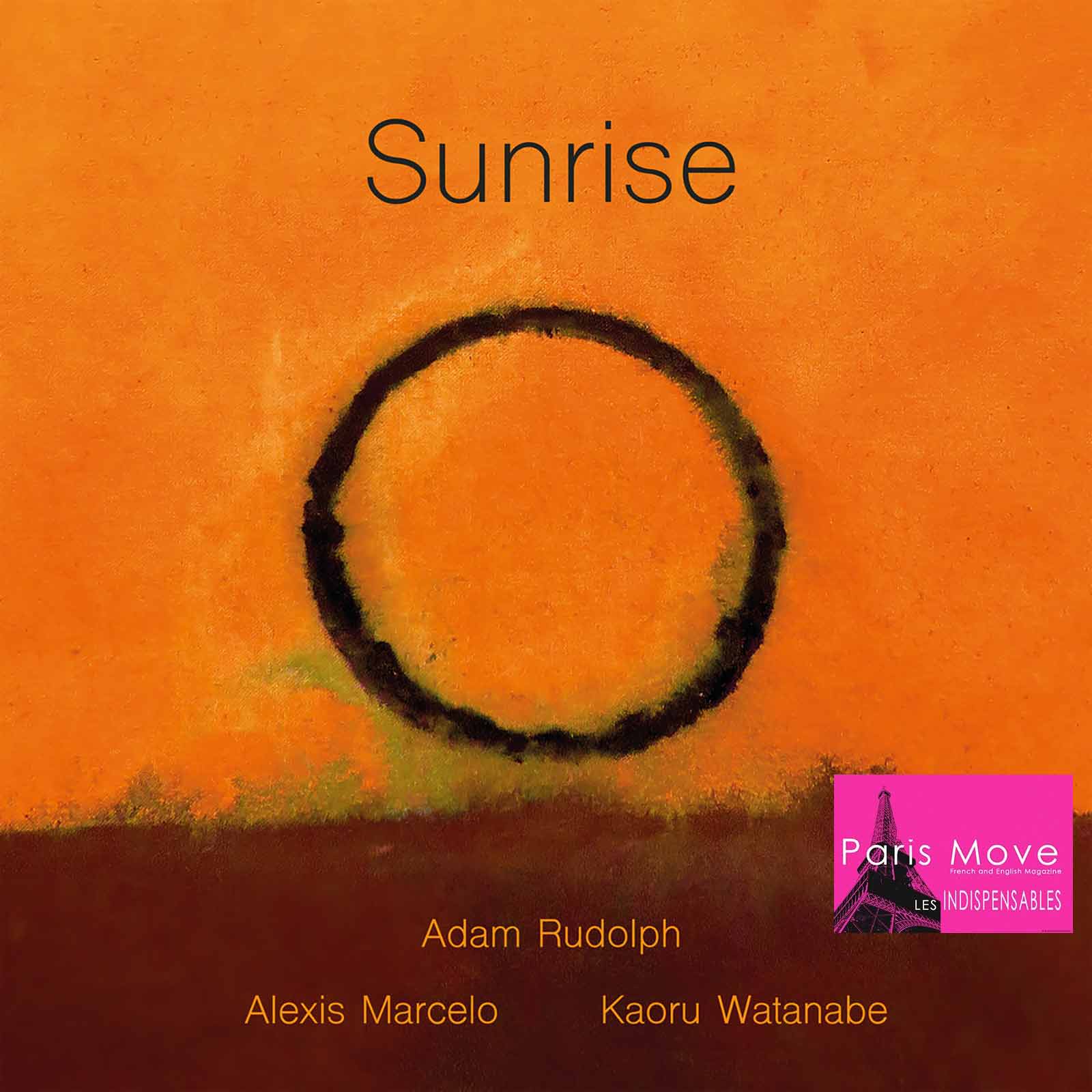
Meta Records – Street date: May 15, 2026
Summary: Adam Rudolph delivers a poetic, immersive album with Sunrise, blending global influences into a cinematic soundscape that rewards deep, attentive listening.
Adam Rudolph’s Sunrise: A Cinematic, Mystical Journey Through Sound
Adam Rudolph recently shared the LP edition of his latest album, also available digitally, a gesture that feels almost deliberate in an era dominated by streaming. With Sunrise, the veteran percussionist offers more than a recording; he extends an invitation into a world shaped by decades of exploration, a deeply personal cartography of sound.
Over the course of a 54-year career, Rudolph has built a reputation as a restless innovator, moving fluidly across traditions and geographies. His work resists categorization, instead forming a language of its own, one that draws equally from ritual, improvisation, and compositional rigor. The result is music that feels both ancient and immediate, grounded yet constantly in motion.
Here, Rudolph introduces a new trio, one that places musicality at the service of imagery and emotion. The album unfolds with a distinctly cinematic logic, where sound functions as both narrative and atmosphere. There are moments that recall the storytelling sensibility of Steven Spielberg, where image and meaning evolve in tandem; except here, the “image” is entirely sonic. Light and shadow, density and space, are treated as compositional elements, guiding the listener through shifting emotional landscapes.
The music moves between abstraction and lyricism, between the poetic and the elusive. It demands attention but does not insist upon it. Instead, it reveals itself gradually. A tone lingers, nearly suspended; textures emerge, overlap, dissolve. Rudolph approaches sound as a painter might approach color, layering, blending, allowing contrasts to coexist without resolution. The effect is immersive, at times disorienting, yet always intentional.
There is, too, a quiet sense of the uncanny. The album occasionally evokes the atmosphere of H. P. Lovecraft, not in theme, but in its capacity to suggest unseen worlds just beyond reach. Lovecraft, who famously dismissed jazz as chaotic, might have resisted the comparison. Yet both artists share a meticulous attention to detail and a rare ability to construct self-contained universes governed by their own internal logic.
Sunrise lives fully within its title. It calls to mind early mornings in half-lit landscapes: a faint breeze carrying a whistling motif, the delicate scent of jasmine drifting through the air. In the distance, figures move with quiet urgency, their purpose unclear. The feeling is one of suspended time, of dreamlike nostalgia. The album’s first half passes almost unnoticed, slipping by with a kind of gentle inevitability. For listeners attuned to its wavelength, it leaves behind a lingering sense of calm and introspection.
Structured like an extended poem, Sunrise follows its own phrasing, its own rhythm, its own internal codes. It marks Rudolph’s 63rd release as a leader or co-leader, yet it feels anything but retrospective. Instead, it captures the immediacy of creation, the spontaneous interplay between musicians shaping dialogue, texture, and form in real time. The trio’s chemistry is evident in the way ideas emerge organically, without force or excess.
This commitment to exploration has long defined Rudolph’s work. As he notes, “With every record I make, I try to do something I’ve never done before.” That ethos is palpable here, not as a statement of intent but as a lived practice.
What emerges is less a collection of compositions than a unified experience, the culmination of a lifetime spent refining a singular artistic vision. Albums like this are rare. They do not simply invite listening; they ask for presence, patience, and openness. In return, they offer something enduring.
Sunrise is not merely heard, it is inhabited. And long after the final note fades, its world remains, quietly unfolding in the listener’s mind.
By Thierry De Clemensat
Member, Jazz Journalists Association
Editor-in-Chief, Bayou Blue Radio
U.S. Correspondent – Paris-Move / ABS Magazine
Musicians :
Adam Rudolph: handrumset (kongos, djembe, tarija), electronic processing, fender rhodes piano, glockenspiel, thumb pianos, overtone flutes, mouth bow, mbuti harp, cup gongs, vocal, percussion
Alexis Marcelo: acoustic piano, electric keyboards, melodica, percussion
Kaoru Watanabe: noh kan, fue and c flutes, taiko, vocal, electric koto and processing
Stephen Haynes: cornet, flugelhorn, conch shell on Tide Activity, Sidereal, and Inception
Track Listing :
Clouds of Joy
Strumbled Upon
Nebula
LunarMind
Sideresl
Inception
A Glimmer Glimpsed
Music spontaneously composed by Adam Rudolph, Alexis Marcelo, Kaoru Watanabe, and Stephen Haynes (on specified tracks)
Organic arrangements, orchestrations, electronic processing, creative direction, and production by Adam Rudolph
Migration Music BMI
Moreno Sounds ASCAP
Yuriru Music ASCAP
Recorded by Greg DiCrosta on May 24 & 25, 2024 at Firehouse 12, New Haven, CT
Mixed & mastered by James Dellatacoma at Orange Music Sound Studio, New Jersey
Cover art by Adam Rudolph
Design by Sylvain Leroux
Special thanks to Noureddine El Warari, Mas Yamagata, and Nancy Jackson
Dedicated to our dear families: Those here, those gone, and those still to come