

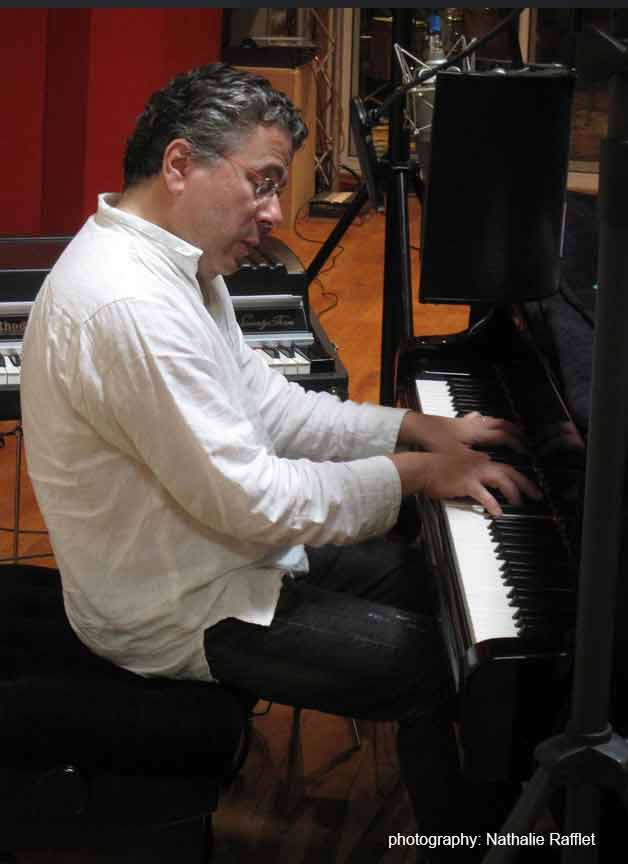
It is impossible to interview Franck Amsallem without touching on one of the still-open wounds of contemporary French history. In 1961, the end of the Algerian War marked the collapse of one of France’s largest colonial empires and triggered the displacement of hundreds of thousands of people. Families fled Algeria to resettle in mainland France and rebuild their lives from nothing, often in a country they barely knew.
Franck Amsallem’s parents were among these exiles. They settled in Nice, in the south of France, bringing with them the family piano. Franck was introduced to classical piano at the age of seven. He gave up formal lessons a few years later: a large family and a cramped apartment were ill-suited to the strict discipline demanded by his teacher. Music, however, remained omnipresent at home. The family owned an extensive collection of 45-rpm records, Ray Charles, Glenn Miller, the Four Tops, sounds that would quietly nourish his musical imagination.
Every artist’s life follows a trajectory, sometimes uncertain, sometimes painful, but always shaped by an ability to dream. When that dream persists, it turns into determination. And that is often enough to carry an artist forward.
Thierry De Clemensat:
Franck, thank you for agreeing to this interview. If you don’t mind, I’d like to begin with your childhood. Do you remember arriving in Nice, and what that transition represented for you as a child?
Franck Amsallem:
I was nine months old when my parents, under extremely difficult circumstances, survived the tragedy of July 5, 1962, in Oran (500 Europeans lost their lives that day), and were able to fly to France, where the rest of my family had already been repatriated. I grew up in this atmosphere of uprootedness, nine people living in a three- or four-room apartment in Nice. Needless to say, the environment was not conducive to practicing an instrument, but my parents insisted that the three youngest children learn piano on the instrument my father had managed to bring with him.
It was a close-knit, loving family, even though the trauma of repatriation and the Algerian War, following that of the Second World War, was ever present. My family had lived in Algeria for generations, and all our customs and traditions were brought with us intact. Even though I have no personal memory of Algeria, my many uncles and aunts and our large family formed a kind of island where customs, expressions, and cuisine constantly reminded us that we were in no way “native” Niçois.
Thierry De Clemensat:
Your initial training was classical, yet jazz quickly became your primary language. For many composers, classical thinking tends to overshadow jazz form. In your case, one senses a rare balance between the two worlds. How did you achieve that harmony?
Franck Amsallem:
Yes, in fact it’s more complicated than that. My early musical education was completely botched by an elderly teacher with very little pedagogical skill, and to be honest, aside from exposure to music, I knew virtually nothing at the age of fourteen when I started playing piano again by ear. At that point, blues and jazz magnetized me, nothing else (high school…) mattered anymore.
Since my parents weren’t musicians and I needed to learn music one way or another, I enrolled at the Nice Conservatory, where I studied classical saxophone while continuing to play piano…by ear. So in a way, I’m a self-taught pianist. If I play jazz piano today, it’s precisely because I never played Beethoven at the conservatory. Conversely, if I didn’t become a jazz saxophonist, it’s because classical saxophone proved to be a straitjacket I could never fully discard.
As a result, I have very mixed feelings about didactic teaching methods that often push us in the opposite direction of what our soul truly desires.
Thierry De Clemensat:
There were your years in Monte Carlo, “the Rock,” as it’s commonly called, where you began familiarizing yourself with jazz standards. What do you remember from that period, and what did it bring you musically?
Franck Amsallem:
It was an excellent on-the-job education. At the time, there was a resident swing orchestra at the Monte Carlo Casino, and I was very young when I was quickly asked to play with them, particularly on Hammond organ, assisting the pianist and bandleader. There were also many hotels and plenty of work.
In a way, it foreshadowed what I later did in New York, playing in all kinds of dance bands. Learning tunes by ear without sheet music, accompanying acts while being a poor sight-reader, everything professional musicians eventually have to know how to do. When I later auditioned for swing orchestras in Boston, I already knew this music well, and many American musicians complimented me on the breadth of my repertoire.
I returned to Monte Carlo a few years later as musical director of a high-level pop orchestra, which also taught me a great deal. It was there, in a sense, that I realized that despite the financial aspect, I had no desire whatsoever to spend my life doing that.
Thierry De Clemensat:
In 1981, I was taking my first steps in radio. For you, it was the Berklee College of Music. That must have been a decisive period. What remains of it today, and did Berklee allow you to make key encounters?
Franck Amsallem:
The shock of learning music the American way was something else entirely! At the time, jazz education in France was still in its infancy, and what I learned at Berklee was essential, despite the academic, and sometimes rigid—side that didn’t really suit me.
I quickly realized that the piano teachers weren’t right for me, so I began taking vocal lessons instead. I focused on jazz arranging and composition, where there were serious heavyweights teaching, Herb Pomeroy, Michael Gibbs, Greg Hopkins. I also worked a great deal on classical piano, which my playing sorely lacked. With the friends I made at Berklee, my musical personality began to assert itself.
Although I’m the first to say that nothing replaces live jazz practice, being able to practice my instrument and write without constraints for several years helped me immensely.
Thierry De Clemensat:
After three years at Berklee, you head to New York, a city in constant motion, the city of Paul Auster’s New York Trilogy. You once again change direction to join the Manhattan School of Music to study composition. You’ve often described this period as a revelation. Why was composition the trigger?
Franck Amsallem:
When I arrived in New York, everything seemed easier, human relationships as well as music. The musicians there played the way I felt music, and I quickly cut my teeth performing with top-level players who encouraged my artistic choices. It’s true that it’s a difficult place to feel comfortable, but the city’s cultural contribution is indescribable.
I chose to study large-ensemble composition with Bob Brookmeyer at the Manhattan School of Music. Brookmeyer remains my guiding reference in that field. His perspective and judgments have stayed with me ever since, even though I don’t write much these days.
I also met great musicians of my generation with whom I would grow musically and record my first albums. I rarely returned to France, and musically I’ve always felt very American—even though American musicians still find me somewhat… French. I play piano like a composer; I dislike pre-fabricated patterns, and I think it was the right choice. In the end, I never took jazz piano lessons because I had no desire for someone to tell me how to play. It was probably a longer road, but infinitely more rewarding.
Thierry De Clemensat:
New York has been your home base for decades now. How does the city continue to influence your writing and your way of thinking about music?
Franck Amsallem:
I left New York after September 11, at least for a time. I kept a few engagements, but since 2002 I’ve been living in Paris. I miss life in NYC greatly. The musicians are impeccable and always positive in their musical approach, and the synergy is always there when I play with both younger and older players.
That may be the most wonderful thing—the way some musicians can read my musical intentions. It’s as if they wrote my original compositions themselves! Recently, I went back to hear the Vanguard Orchestra, which is something of a reference big band. That large-ensemble sound, that sonic mass, that’s New York.
Thierry De Clemensat:
We share the same observation about the musician’s craft: there are many good pianists, but few truly stand out. In your view, what makes the difference between those who leave a lasting mark and the others?
Franck Amsallem:
A certain kind of searching, not originality at all costs (that’s more European than American), but the existential question every musician must ask: what sound, what music defines my personality? Going all the way with that question leads to an answer that is always personal, of course. But many musicians spend their time looking sideways and avoiding the answer.
So how do you stand out? Be yourself. What does that mean? How do you do it? Those are the questions one must answer, and it takes a lifetime. Many well-known musicians spend their time sounding like others, and critics often don’t notice.
Thierry De Clemensat:
Your discography spans more than thirty-five years, from 1990 to 2025, with fourteen albums to your name. Do you still remember recording your first album, Out a Day, with Gary Peacock and Bill Stewart?
Franck Amsallem:
Of course. I was at a crossroads, I was playing a lot, but not always under great conditions, and I needed an album that would make an impression. I decided to ask these remarkable musicians, who fully embraced the project and made me sound good.
Gary is incredibly free on that recording and clearly happy to make the trio sound the way it does. I learned an enormous amount over those two days, and Bill also asked me to redo several takes because he felt he could do better. Making music with musicians of that caliber doesn’t happen every day.
I also love the sound of the recording, captured at the legendary Clinton Studios. Everything was recorded in direct stereo, no headphones, no separation, just like a concert. The album has been reissued several times and contributed greatly to my recognition.
Thierry De Clemensat:
With such a rich body of work, are there albums in your catalog that you feel closer to today? And why?
Franck Amsallem:
I believe all my albums were recorded with a clear intention. In each one, there are moments of musical happiness I’m very proud of. Whether live or in the studio, I think I manage to focus on the present moment to bring out the best of what lies beneath, and from experience, I can say that’s not always a given.
I have no regrets; all my albums have their own distinct character. The most recent quartet album, Gotham Goodbye, with strong cohesion and a saxophonist, Irving Acao, who truly understands what I like, is also one of my favorites. The energy is very present, and once again the sound of the record is magnificent.
Thierry De Clemensat:
Listening to your records, one gets the sense that your compositions gain density and depth over time. Do you feel that writing has become an accumulative process, ideas set aside, refined, and revealed over the years and encounters?
Franck Amsallem:
It’s certain that when composing, you must constantly know how to edit yourself and avoid repetition. Composition is a mirror of who you are, and those few short minutes during which the theme is played must also serve as the perfect springboard for improvisation.
There’s no need to compose a great deal, rather, to compose with discernment and intention. Composition has this special quality: some themes I wrote early in my life still define who I am today. Joe Henderson used to say that, and he continued playing pieces he wrote when he was young until very late in his career.
In the end, as with standards, it’s about the relationship between who I am now and who I was then. Ultimately, jazz is simple in 90% of cases: a theme, then an improvisation. The multitude of questions that arise stem from that: how do you play the theme and improvise at the beginning, in the middle, and at the end of your career?
Thierry De Clemensat:
Your music often sits at the boundary between structure and freedom. How do you decide when a piece needs to breathe, and when it requires a more formal framework?
Franck Amsallem:
Music must always be of the greatest interest. What does it need at that precise moment? Asking the right questions while listening to our takes or studying our scores may be the most important thing of all. What could have been added or removed to improve the musical content? Above all, not dodging what must be done to improve is a question one must ask oneself every day.
Thierry De Clemensat:
You’ve collaborated with musicians from very different backgrounds. What do you look for first and foremost in a musical partner?
Franck Amsallem:
Someone who complements me, and someone who stimulates me. Finding a musician who can contribute to the structure I’m building, who’s on the same wavelength, speaking the same language, and with whom I can play with my eyes closed and 100% trust, while also bringing a personal touch, ideas, notes, phrases I wouldn’t have thought of, that stimulate me and open new horizons.
That’s the case, for example, with drummer Kush Abadey, whom I used on my latest recording. A drummer who works within the tradition and can quickly take flight toward other horizons. Support and inspiration.
Thierry De Clemensat:
How has your relationship with the piano evolved, from an instrument associated with childhood discipline to a true vehicle for personal expression?
Franck Amsallem:
The piano is unique in that 99.9% of pianists start by playing some amount of classical music before moving on to other styles. In my case, there was little classical at first, then learning by ear during my teenage years.
Even with very good pianists, one sometimes feels that the classical straitjacket prevents truly personal expression. Hence the lifelong task of reconnecting with the child who once stumbled at the piano and being able to express oneself without unnecessary artifice. That doesn’t negate the need, this is where it gets tricky, to play with a technique that allows you to express everything you want.
So you must work on both the natural and the sophisticated. A heavy task. In my case, after studying with a formidable classical teacher, Phil Kawin, I abandoned classical practice around the age of thirty, having absorbed many valuable things and secrets of sound and technique. The challenge was to assimilate everything I had learned and use it wisely as a jazz pianist.
Thierry De Clemensat:
In the age of streaming and fast consumption, how do you continue to think of the album as a coherent, complete artistic work?
Franck Amsallem:
I’m still very much attached to the classic conception of the album or CD, with slow and fast pieces strategically placed. Streaming has its pros and cons. It contributes to the frenetic consumption of music we’re witnessing, without necessarily benefiting musicians financially.
I take it into account sometimes, but truth be told, I’m not particularly skilled at benefiting from the system.
Thierry De Clemensat:
Teaching plays an important role in your career. Beyond technique and harmony, what would you most like to pass on to young musicians?
Franck Amsallem:
Jazz education has evolved greatly, for the better! Thanks to the abundance of videos and the incredible tool that is the internet for disseminating culture, yes, culture, because information must be shared.
When I was twenty, in 1981, it was the Stone Age, even in the U.S. and in France, even more so! The general level today is absolutely incredible. If students come to me, I’ll talk about my experience in acquiring phrasing, repertoire, and the knowledge required to play jazz, based on my own journey.
I’ll talk about the necessary work, devotion to this music, because in my case, it’s really been a lifetime devoted to jazz. If you want to reach a high level, there’s no way around it. I’ll pass on my love of swing, American melodies, the blues, and all those things you only find in jazz.
Thierry De Clemensat:
Looking to the future, are there still musical territories, stylistic, geographical, or emotional—that you feel the need to explore?
Franck Amsallem:
I’d like to envision a meeting between a jazz quartet and a classical string quartet that would synthesize my experience of both worlds. Many times, the result doesn’t quite live up to expectations. In other words, there’s still a lot of work ahead if I’m to live up to my ambitions.